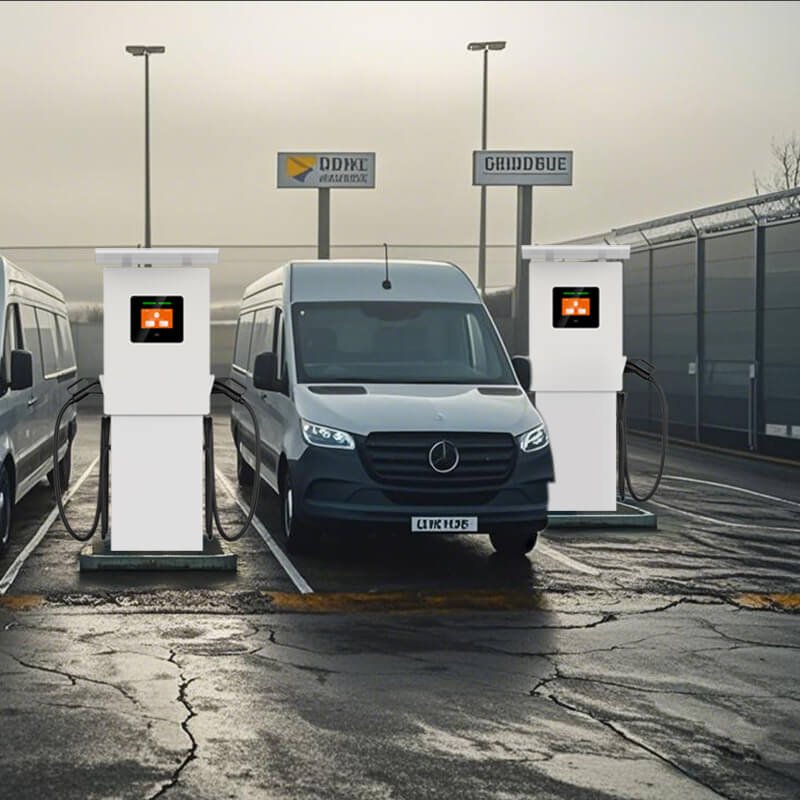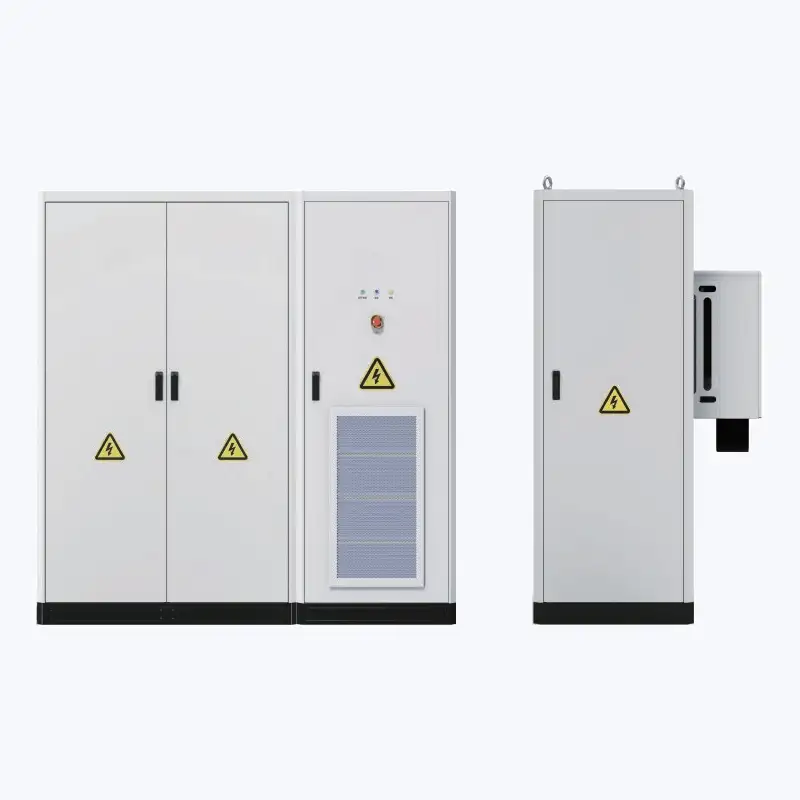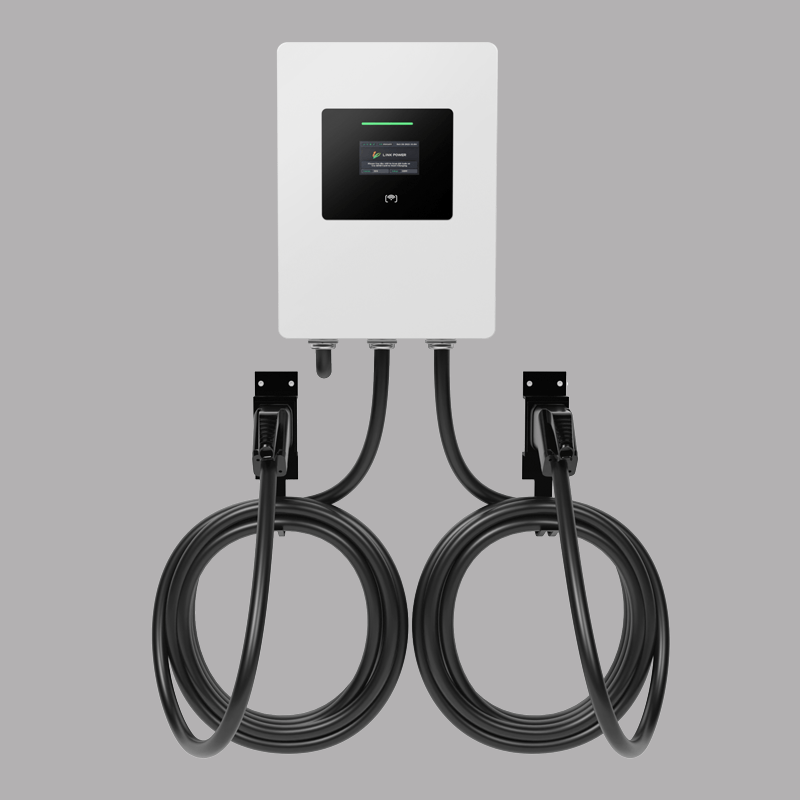
Model:L3D-DC28kW-2,Engineered for 208V 3 Phase EV Charger. Its core adaptive load balancing system enables either 14kW concurrent dual-vehicle charging or 28kW max-rate solo charging. The unit offers dual-protocol support for both CCS1 & NACS, while a broad voltage spectrum of 350-750V services most EVs. With proven all-weather resilience (IP54, -30~55°C) and 96.5% superior energy conversion, this is a truly advanced powering solution.


| Model Name | L3D-DC28kW-1 | L3D-DC28kW-2 |
|---|---|---|
| Power Input | ||
| Phases /Lines | L+PE+N | 3P+PE+N |
| Voltage | 1P 240Vac(±10%) | 3P 208 / 480Vac(±10%) |
| Frequency | 45-65Hz | |
| Power Output | ||
| Charging Outlet | 2*CCS1/2*NACS/CCS1+NACS | |
| Voltage(DC) | 150-750V /350-750V | |
| Current(Max) | 80A | |
| Power(Max) | 14kW*2/28kW | |
| Dimension(W×D×H) | 580mm × 250mm × 770mm(22.83' × 9.84'' × 30.32'') | |
| Weight | 165.76lbs | |
| Charger v.s. EV | PLC(DIN 70121: 2012/ISO15118-2: 2013) | |
| Communication Protocol | OCPP1.6 J / OCPP2.0.1 | |
| Certification | UL 2594, UL2231-1/-2 | |
A powerful 208V 3-phase DC EV charger, delivering up to 28kW of DC fast charging to significantly reduce vehicle charging time.
The smart load-balancing system enables 14kW concurrent DC charging for two vehicles or 28kW max-rate solo DC charging, balancing efficiency and convenience.
With superior 96.5% energy conversion and IP54 all-weather resilience, this is an efficient and reliable 208V 3-phase DC charging station.
Supporting CCS1 and NACS protocols with a 350-750V wide voltage range, this is the ideal DC fast charging solution for a wide range of commercial EVs.
Innovative EV charging solutions cater to diverse needs across various industries, offering efficient home EV chargers including home AC chargers for residential settings, as well as robust commercial DC fast chargers tailored for businesses seeking rapid and reliable charging infrastructure.
Monitor charging status through data analysis to adjust strategies in real-time, achieving optimal resource allocation.
Equip parking lots with multiple EV chargers, offering flexible charging options for commuters and long-term parkers.
Integrate EV fast chargers at Fueling stations for convenient charging during refueling stops or long-distance travel breaks.
Install home-friendly EV chargers in residential areas to ensure reliable overnight charging for daily vehicle usage.
Zero-Clean & Employee Loyalty Synergies, Artificial Intelligence for Energy Savings, EV Support , Cloud-Controlled Brand Equity
Business trips made smarter. Choose hotels with EV charging to power your meetings and your EV,Leading hotels with EV charger
The Dual DC Fast Charger allows businesses to serve more customers by charging two electric vehicles at the same time. This dual charging feature optimizes space and reduces wait times, enhancing the overall customer experience. For commercial environments like fleets, service centers, or retail locations, it offers an efficient way to increase charging station throughput and generate higher revenue.
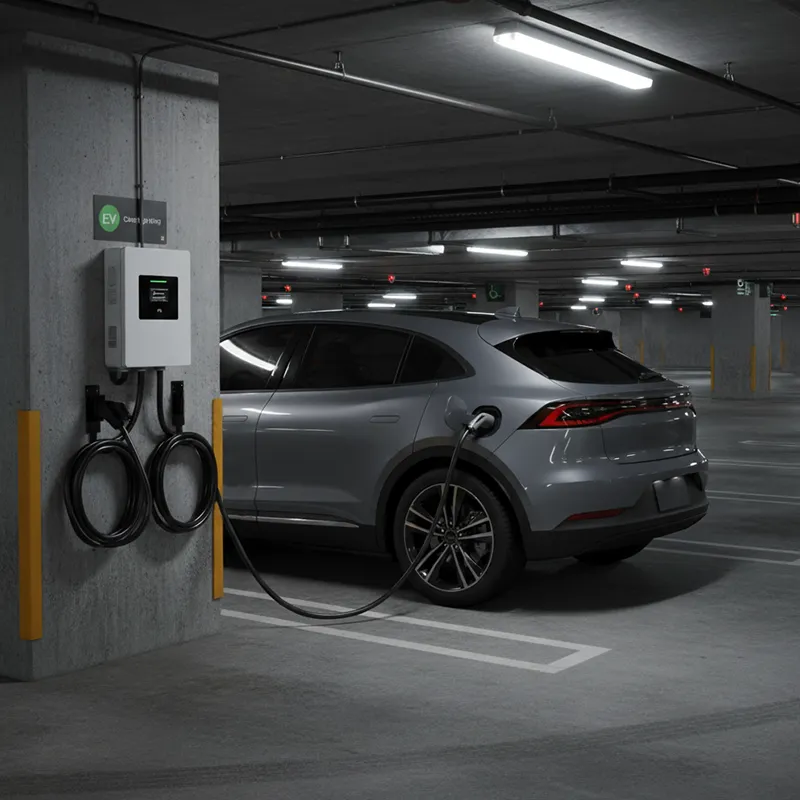
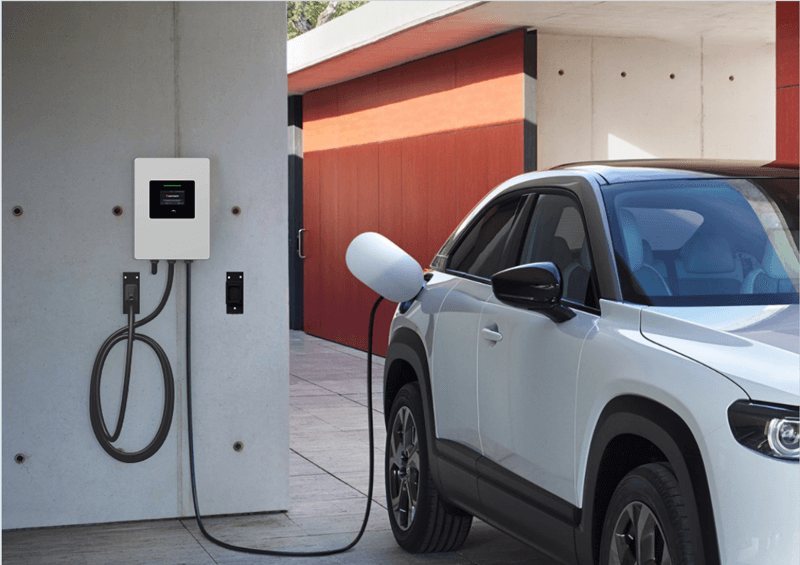
With advanced DC fast charging technology, this unit ensures that vehicles are charged at industry-leading speeds, minimizing downtime for both fleet operations and customers. The fast charging capabilities help reduce the time spent waiting, making it ideal for high-traffic commercial spaces, where efficiency and quick service are paramount to customer satisfaction.
“We chose this 208V 3 Phase DC EV charger for its dual-port capability, which has significantly improved our fleet’s charging efficiency. The load-balancing feature is a game-changer, allowing us to serve more vehicles without costly infrastructure upgrades. The performance has been flawless.”
— John Davis, Fleet Manager
Eco-Logistics (California, USA)
“The reliability of this charger is unmatched. We operate in harsh weather conditions, and the IP54-rated resilience of this unit has never failed us. The DC fast charging capability is exactly what our clients need, and the dual CCS1 & NACS protocol support means we’re ready for the future. It’s a top-tier solution.”
— Sarah Jenkins, Operations Director
Future Mobility Solutions (Ontario, Canada)

Remote Monitoring & Data Analytics
Our EV Charging Management Software is the brain of your charging station. Through our powerful cloud platform, you can remotely monitor the real-time status of all charging stations, view historical data, and perform data analysis to inform your business decisions.
Automated Payments & Revenue Management
The software supports multiple payment methods and flexible pricing strategies to help you easily achieve automated revenue. You can set different charging rates based on time of day, power level, or user groups, and automatically generate financial reports to ensure your return on investment is maximized.
Quickly identify and resolve issues to minimize downtime.
Ensure your devices are always up-to-date and secure.
Provides a seamless charging experience to attract more EV drivers.
Easily integrate with your business systems for data synchronization.
DC chargers themselves are not three-phase, but they typically require a three-phase power input to operate. The internal converters of a DC charger take in AC power (usually from a three-phase source) and convert it into the DC power that an EV battery needs. So, while the charger outputs DC, its high-power operation relies on a three-phase AC power supply.
Yes, you can get a three-phase EV charger, which usually refers to an AC charger. Three-phase AC chargers are very common in Europe and Asia, providing faster AC charging speeds (e.g., 11kW or 22kW) than single-phase chargers. In North America, where single-phase power is standard in homes and many businesses, three-phase chargers are less common, but high-power commercial chargers (like DC fast chargers) do use three-phase power.
This question can be a bit confusing because three-phase and DC are two different types of electrical power, and they are typically complementary, not alternatives.
Three-phase refers to AC power, which is highly efficient for transmitting and distributing large amounts of energy.
DC refers to the type of power that an EV’s battery stores and uses.
Therefore, AC chargers use three-phase power and are slower than DC fast chargers. DC fast chargers, in turn, use three-phase power as their input and convert it to DC power inside the station to deliver it directly to the EV. So, it’s not “using three-phase instead of DC,” but rather “using three-phase power to enable efficient DC charging.”
Yes, in many cases, three-phase power is better for EV charging due to a few key reasons:
Higher Power and Faster Speed: Three-phase power can carry a higher current and power, enabling faster AC charging (e.g., 22kW) compared to single-phase chargers which are typically limited to 7.4kW.
Greater Efficiency: Three-phase systems are more efficient and balanced when handling and delivering large amounts of power.
Enables DC Fast Charging: High-power DC fast chargers almost exclusively rely on three-phase power input to deliver charging speeds of 50kW, 150kW, and even higher.
Not all EVs can use a Level 3 charger, also known as a DC fast charger.
Compatibility: The vehicle must be equipped with a DC fast-charging port (CCS, NACS, or CHAdeMO) to use a Level 3 charger. Many older EVs or some plug-in hybrids may not have this capability.
Maximum Charging Rate: Even if the car supports DC fast charging, it has a maximum charging rate it can accept. For example, if an EV’s maximum is 50kW, it won’t charge faster than that, even when connected to a 150kW charger.
Battery Condition: The battery’s current state of charge, temperature, and health also affect charging speed. The charging rate will automatically slow down when the battery is nearly full or if its temperature is too low or too high.
Discover the ETL 28kW DC Fast Charger and experience an efficient, flexible, and future-ready solution.
From initial consultation to seamless installation, our expert team delivers custom EV charging solutions tailored to your business needs.
We will send detailed technical info and quotation to you!