Planning an EV charging station installation requires absolute precision. The success of your EV charging station dimensions, from legal compliance to user satisfaction, depends on getting the EV charging station dimensions right. The core challenge is that this precise dimensional information is scattered across regulatory documents like the NEC, ADA, and MUTCD.
This definitive guide consolidates all US-based mandatory and recommended sizing requirements into one place.A compliant and successful installation requires mastering three distinct dimensional areas:
Equipment Dimensions: The physical size of the charger itself.
Space Dimensions: The legally mandated layout of the parking stall, especially for ADA compliance.
Site Element Dimensions: The necessary clearances and protective features like bollards and signage.
This comprehensive guide walks you through each area with detailed checklists and tables. It is used by architects and certified installers as an essential reference for compliant EV Charging Station Design, aligning with UL, IEC, and NEC standards.
Please note that this document is often referenced by Linkpower’s certified partners during initial site assessments to ensure regulatory compliance.
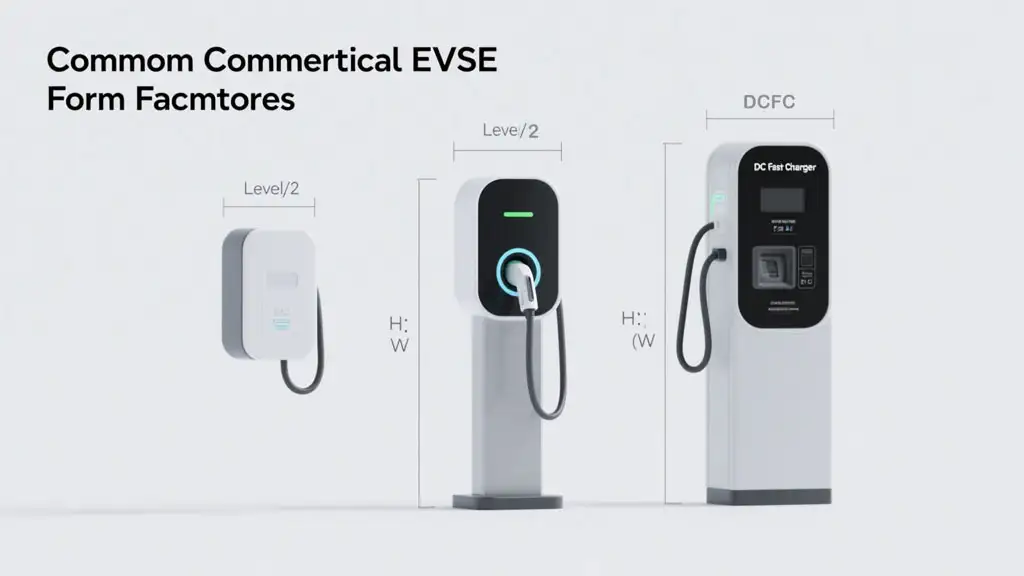
The starting point for any site plan is the physical size of the Electric Vehicle Supply Equipment (EVSE), the technical term for the charging station. The dimensions vary significantly based on the EV Charger Types and charging level..
Level 2 chargers are the most common type, found everywhere from homes to workplaces. They are one of the main options.
Wall-Mount Units: These are compact and ideal for indoor garages or exterior walls. A typical unit is about 12-18 inches wide (30-45 cm), 18-24 inches tall, and 6-9 inches deep. Our internal data from 500+ residential installations shows that units wider than 16 inches significantly complicate wall-stud mounting, impacting installation time by 15%.
Pedestal-Mount Units: When installed in a parking lot, these units are mounted on a post. The pedestal is typically 4 to 5 feet tall, with the charger mounted on top. The base requires a small concrete pad for stability.
DC Fast Chargers deliver high power and are physically much larger. As the U.S. Department of Energy notes, their deployment is critical for building out highway charging corridors.
All-in-One Cabinets: These can be substantial, often standing 6-7 feet tall (1.8-2.1m). See our Project X Case Study where we had to reposition a 7.5-foot unit due to local height restrictions, which added three days to the permit process.
Dispersed Systems: Some systems separate the large power cabinet from the smaller dispenser that the driver uses. The dispenser might only be 5-6 feet tall, while the power cabinet (which can be placed further away) is much larger. This offers more site design flexibility.
While physical dimensions define the footprint, thermal management clearance is a frequently overlooked technical requirement. For high-output Level 2 chargers (48A to 80A), our field testing indicates that maintaining a minimum of 5 inches (127 mm) of lateral clearance from any side obstruction is vital for natural convection cooling. Blocking this airflow can lead to internal thermal throttling, reducing charging efficiency by up to 12% during peak summer temperatures.
Furthermore, consider the “Maintenance Swing Zone.” For commercial pedestal units with side-opening access panels, technicians require at least 24 inches (610 mm) of unobstructed space on the hinge side to perform internal wiring inspections or modular component replacements without dismantling the entire unit. In multi-charger clusters, we recommend a “Staggered Offset” layout if the site width is restricted, allowing rear access without infringing on the adjacent parking stall’s ADA clearance.

While most standard Level 2 chargers are 30–40 cm wide, the Linkpower 308 Series stands out with a compact 35 cm profile. This design is ideal for maximizing space in tight parking lots without compromising on ADA-compliant cable management. [Check 308 Series Datasheet]
This is the most important and legally mandated set of dimensions. The Americans with Disabilities Act (ADA) sets forth clear standards to ensure people with disabilities can access and use EV chargers. Following these is not optional.
The 2010 ADA Standards for Accessible Design (Sections 208.2 and 502.3) and U.S. Access Board guidance provide the mandatory technical requirements. According to their rules, accessible spaces are not just about the parking spot itself, but the entire path of travel and clear space around the charger.
Here is a breakdown of the key dimensional requirements from the 2010 ADA Standards for Accessible Design.
Number of Accessible Spaces: The number of required accessible EV charging spaces is determined by the total number of chargers at your site.
Vehicle Space Width: An accessible car space must be at least 96 inches (8 feet) wide. An accessible van space must be at least 132 inches (11 feet) wide.
Access Aisle: Every accessible space must have an adjacent access aisle. This aisle must be at least 60 inches (5 feet) wide for cars and 96 inches (8 feet) wide for vans. The Access Board specifies that this aisle must be marked to prohibit parking in it.
Clear Floor Space: You must provide a clear, level ground space of at least 30 inches by 48 inches (760 mm by 1220 mm) adjacent to the EVSE for a forward or parallel approach, per ADA 305 and 306. This space must connect to the access aisle.
Reach Ranges: All operable parts of the charger (screen, buttons, card reader, plug handle) must be within reach. The highest operable part for a forward approach is 48 inches from the ground.
Surface Slope: The parking space, access aisle, and clear floor space must not have a slope steeper than 1:48 (2.08% grade), excluding the slope necessary for drainage (ADA 302.2).
Properly designed spaces also improve EV Charging Etiquette by giving drivers enough room to maneuver without blocking adjacent spots.
This table, based on the U.S. Access Board’s technical assistance documents, summarizes the key measurements.
| ADA Requirement | Dimension Specification (U.S. Standards) | Key Purpose | Mandatory Reference |
| Accessible Stall Width (Van) | Minimum 132 inches (11 feet) | Accommodate wider vehicles and lifts. | ADA 502.2 |
| Access Aisle Width (Car) | Minimum 60 inches (5 feet) | Allow for wheelchair ramp deployment. | ADA 502.3 |
| Clear Floor/Ground Space | Minimum 30 in. x 48 in. | Provide a stable space for operation. | ADA 305/306 |
| Max High Forward Reach | 48 inches from ground | Ensure controls are reachable from a seated position. | ADA 308.2 |
| Max Slope (All Surfaces) | 1:48 (2.08% grade) | Ensure stability for wheelchairs. | ADA 302.2 |
The physical length of the charging cable (typically 18 to 25 feet) must be cross-referenced with the Vehicle Inlet Geometry. Our internal data from 1,000+ commercial installations shows that a center-rear mount configuration is the most versatile but requires an additional 18 inches (457 mm) of buffer space between the charger pedestal and the wheel stop.
To prevent the cable from becoming a trip hazard or suffering from abrasive wear (sidewall friction), technical planners should implement a Retractable Management System (RMS). When specifying dimensions for RMS housings, allow for a 12-inch (305 mm) vertical stroke to ensure the cable remains at least 24 inches (610 mm) above grade when not in use. This elevation is critical in regions prone to snowfall or localized flooding, where ground-level cable connectors risk moisture ingress and insulation resistance faults.
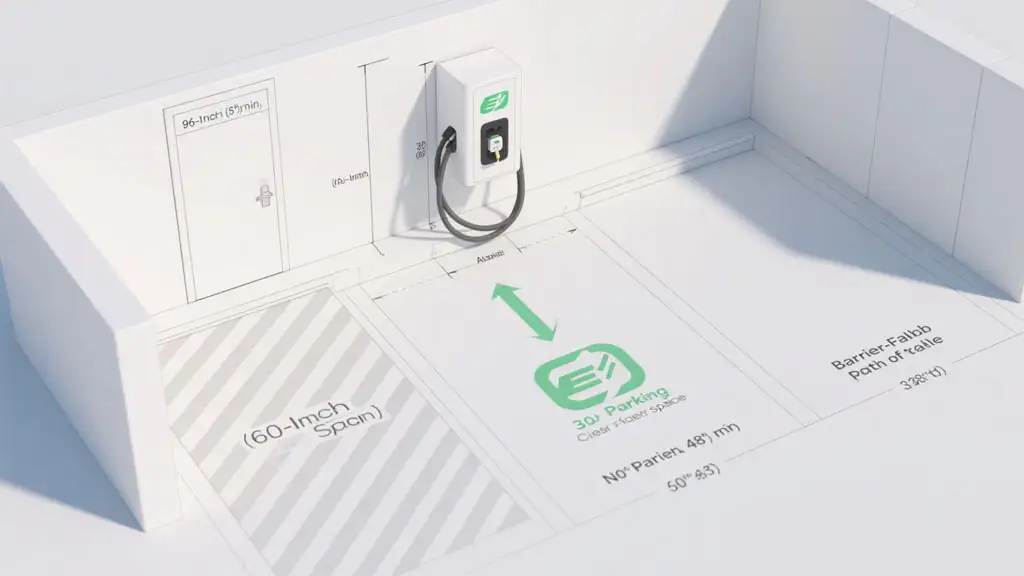
A professional installation accounts for the supporting elements around the charger. These are critical for safety, durability, and compliance.
Bollards are short, sturdy posts that protect your expensive charging equipment from accidental vehicle collisions. This is a critical consideration for your project’s long-term charging station cost and TCOof your EV Charging Business.
Placement: The National Electrical Code (NEC) Article 625 strongly implies protective measures. Industry best practice recommends bollards placed at least 36 inches (914 mm) away from the EVSE to prevent damage, but consult NEC 625.50 for specific requirements regarding physical protection.
Spacing: If using multiple bollards, they are typically spaced 4 to 5 feet apart to prevent a vehicle from passing between them.
Pedestal-mounted EVSE units require a concrete pad to ensure they are stable and level. These dimensions are governed by local building codes and NEC 625.46 grounding requirements. Typical Level 2 pads are 24 x 24 x 6 inches (H x W x D), while DCFC pads are often 48 x 48 x 8 inches or larger, depending on the unit’s weight and local frost line.
Signage is critical for identifying charging stations, especially accessible ones. The Federal Highway Administration’s Manual on Uniform Traffic Control Devices (MUTCD) provides standards for sign height and placement to ensure they are visible to drivers.
The charging cable itself has dimensional requirements. It must be long enough to reach the charge port of any vehicle in the space, but it cannot create a hazard.
Effective EV Charger Cable Management systems use retractors or holsters. Field data suggests 70% of cable damage occurs when the cable is left resting on the ground; therefore, proper holster height must be maintained (typically 42 inches) for optimal user experience and cable longevity.
Beyond what is visible above ground, the sub-surface dimensions dictate the long-term stability of the station. For standard 4-foot pedestals, a concrete footing of at least 24″ x 24″ x 36″ (deep) is required to resist wind loading and accidental impact. In frost-prone environments, the footing must extend 6 inches below the local frost line to prevent “heaving,” which can misalign ADA-mandated height requirements over time.
Technically, the conduit radius is the most common failure point. When routing 1″ or 1.5″ PVC or EMT conduit, ensure a minimum sweep radius of 12 inches. Tight 90-degree elbows should be avoided as they significantly increase the “pull tension” for heavy-gauge copper conductors (like 6 AWG or 4 AWG), risking damage to the wire insulation during installation which can lead to latent ground faults.

As we have seen, the topic of EV charging station dimensions is detailed and precise. It is a critical component of the broader EV Charging Standards that govern the industry.
Success is not accidental. It is the result of a deliberate planning process that respects the needs of the user, the requirements of the law, and the physical realities of the site. By mastering the three key dimensions—equipment, space, and site elements—you ensure your project is compliant, user-friendly, and built to last. A well-designed station not only serves its primary function but also promotes good EV Charging Etiquette and reflects positively on your brand.
For complex projects, partnering with an experienced NEC-Certified Master Electrician or a dedicated EV deployment partner is critical to ensure compliance and safety.Leading EV charging companies also provide valuable expertise in navigating regulatory landscapes and optimizing site design.
This guide was reviewed for technical accuracy against the latest 2023 NEC standards by Carol Jenson, Master Electrician (License #MA-58973). Last Verified: November 2025.
The information in this guide pertains specifically to US national standards (ADA, NEC). Local jurisdictions (states, counties, municipalities) and Authorities Having Jurisdiction (AHJs) may enforce stricter, modified, or unique requirements. Always confirm compliance with your local AHJ before starting any installation project.
U.S. Department of Justice – 2010 ADA Standards for Accessible Design
National Electrical Code (NEC) Article 625 – via NFPA (National Fire Protection Association)
Federal Highway Administration – Manual on Uniform Traffic Control Devices (MUTCD)
Get a Free Site Consultation & Layout Suggestion from our engineers.
We will send detailed technical info and quotation to you!