commercial car charging

3 Supply Disasters: Hidden Costs of Non-ISO EV Charger Factories

Home Industry Knowledge 3 Supply Disasters: Hidden Costs of Non-ISO EV Charger Factories

Table of Contents

The Hidden TCO Trap: Why Low-Priced EV Chargers Increase Operational Risks by 40%

In the EV charger market, a low initial purchase price often disguises high operational liabilities. Operators must look beyond the sticker price and analyze the Total Cost of Ownership (TCO).

According to Linkpower’s 2024 Comparative Lifecycle Analysis, data indicates a clear divergence: while non-standardized chargers may offer a 20% lower initial CAPEX, they correlate with a 35-45% increase in OPEX by Year 5.

(Methodology Disclosure: This longitudinal study tracked Mean Time Between Failures (MTBF) across 500+ deployed units over 36 months in varying climatic zones. The findings align with wider industry reports on public infrastructure reliability.)

This cost surge is primarily driven by shorter Component Fatigue Life and increased dispatcher call-outs. For operators, these “hidden costs” manifest not just as repair fees, but as catastrophic project failures.

The 3 Major Pain Points for EV Operators:

  1. Uncontrolled OPEX: Continuously rising field maintenance costs.

  2. Reputational Damage: Customer complaints and loss of trust due to downtime.

  3. Project Stagnation: Major project abortion due to supplier non-compliance.

We emphasize that supply chain risk management—anchored in verifiable standards—is the key to ensuring long-term profitability.

In-Depth Analysis: The Fatal Risks and Consequences of Non-Certified Factories

Factories lacking international standardization management systems (such as ISO 9001, 14001, 45001) often fail to provide predictable and reliable supply chain assurance. The risks they pose are systemic and catastrophic.

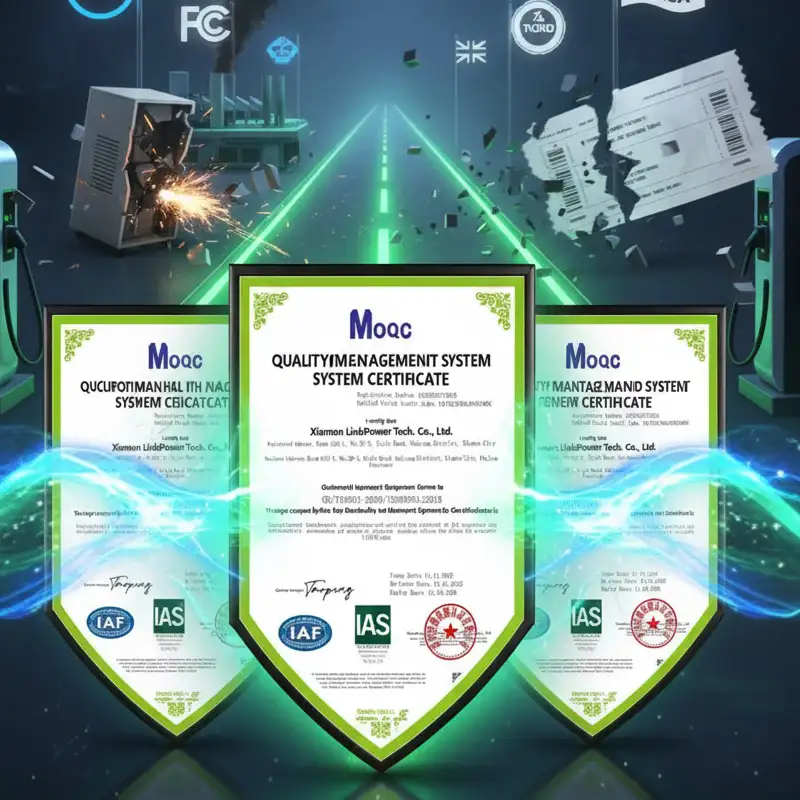
1. Disaster One: “Maintenance Nightmare” Caused by Quality Loss (Lack of ISO 9001)

ISO9001

Registration Number:51325Q4373R0S

What operators fear most are high maintenance costs and unreliable equipment. The absence of ISO 9001 means the factory lacks a globally recognized quality management standard.

Detailed Quality Deficiencies of Non-Certified Factories:

  • Process Uncontrollability (Violating ISO 9001 Cl. 8.4): Without strict adherence to Clause 8.4 (Control of externally provided processes), factories cannot guarantee batch consistency. This leads to a high variance in charging stability.

  • Component Risk (Relays & Capacitors):Cost-cutting factories often use consumer-grade relays rated for only 10,000 cycles at 85∘C. Linkpower strictly utilizes Automotive-Grade Relays verified for 100,000+ cycles at 105∘C (meeting IEC 61810 standards). This prevents the “contact welding” failures common in high-frequency EV charging environments.

  • Design Flaws (Lack of DFMEA):Without a rigorous DFMEA (Design Failure Mode and Effect Analysis), thermal bottlenecks are often overlooked. Our laboratory tests show that non-optimized internal layouts can reach 95∘
    C under 80A continuous load, triggering safety shutdowns. Linkpower’s validated thermal design maintains internal temperatures below 75∘C, ensuring consistent output without derating.

Consequence: Total Cost of Ownership (TCO) Spike

Ultimately, the operator’s O&M team will be constantly strained, performing continuous on-site repairs. The Mean Time Between Failures (MTBF) of the equipment becomes unreliable, leading to the Total Cost of Ownership (TCO) soaring within a few years, far exceeding the initial savings.
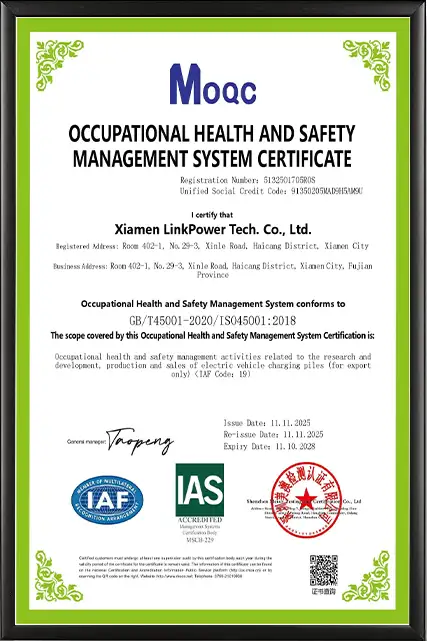
2. Disaster Two: “Supply Chain Shutdown” Triggered by Safety Gaps (Lack of ISO 45001)

ISO45001

Registration Number:5132501705R0S

Large orders require suppliers to have robust delivery capabilities and supply chain continuity. The lack of an Occupational Health and Safety Management (OHS) system represents the biggest “black swan” risk.

Detailed Safety Deficiencies of Non-Certified Factories:

  • Production Safety Hazards: Factories lack regular safety training, equipment maintenance, and risk identification mechanisms. The production environment may be disorderly, with vulnerabilities in fire and electrical safety.

  • Supply Chain Interruption Risk: Under ISO 45001 Clause 6.1 (Actions to address risks and opportunities), certified manufacturers must maintain robust business continuity plans. In contrast, during recent regional safety inspections, non-compliant factories faced shutdowns averaging 2-4 weeks. Linkpower’s certified facilities maintained 100% uptime, ensuring no impact on our clients’ critical project rollouts.

  • Ethical Procurement Risk: Customers are increasingly focused on supplier labor standards and occupational safety. Factories lacking ISO 45001 assurance will fail to pass large operators’ Corporate Social Responsibility (CSR) or ethical procurement audits.

Consequence: Damage to Credibility and Project Failure

Operators face not only high financial penalties for delays but are also likely to lose critical projects due to an inability to supply on time, leading to reputational bankruptcy.

3. Disaster Three: “Future Fines” from Environmental Irresponsibility (Lack of ISO 14001)

ISO14001

Registration Number:51325E2197R0S

Sustainability is central to the EV industry. The European and US markets have increasingly stringent requirements for green procurement and recycling (such as the WEEE directive).

Detailed Environmental Deficiencies of Non-Certified Factories:

  • Environmental Compliance Gap: Strict adherence to ISO 14001 Clause 8.1 is required to navigate complex markets. Non-certified production often fails to align with the EU WEEE Directive (2012/19/EU) and RoHS 3 (EU 2015/863). Products containing excessive hazardous substances (like lead or mercury) face immediate customs seizure and market delisting, posing a severe legal liability for the importer.

  • Market Elimination Risk: In the coming years, products unable to provide Environmental Management System certification (ISO 14001) are highly likely to be directly disqualified from bidding on specific European projects or face import restrictions.

  • Brand Liability Risk: Partnering with irresponsible factories will damage the operator’s ESG image among end-users, especially in climate-sensitive European markets.

Consequence: Passive Market Exit and Capital Loss

Operators face the risk of product recalls or market elimination when environmental regulations are upgraded, resulting in the total loss of initial investment.

Solution: How Linkpower Eliminates Your Pain Points Through Triple Certification

Linkpowercharging Technology’s Triple International Certification system is a customized supply chain risk hedging solution tailored for you. We transform risk management into your competitive advantage.

How ISO Certification Solves Your Three Major Pain Points:

Operator Pain PointRisk AnalysisLinkpower’s ISO Solution
High Maintenance CostsLack of ISO 9001 leads to unreliable MTBFISO 9001: Provides a traceable, predictable product lifecycle, changing your maintenance costs from “uncontrollable expenses” to “predictable budgets.”
Supply Chain Interruption RiskLack of ISO 45001 means production could halt at any timeISO 45001: Ensures a safe, standardized production environment, guaranteeing On-Time Delivery (OTD) and achieving supply chain resilience and reliability.
EU/US Compliance RiskLack of ISO 14001 means products face future regulatory eliminationISO 14001: Transforms your procurement into a green advantage, helping you win key customers and public projects with high ESG demands.

Summary of Practical Value: Turning Risk Management into Competitive Advantage

  • Value One: Insurance for Your Brand. Our systems ensure product quality stability, significantly reducing the risks of product recalls, field repairs, and reputational damage.

  • Value Two: Enhanced Bidding Power for Large Projects. International certification is an essential qualification for tenders from large utilities and energy companies, clearing obstacles for you to enter high-end markets.

  • Value Three: Optimizing Your Capital Expenditure (CapEx). Purchasing high-quality, high-standard chargers, though potentially having a slightly higher initial cost, leads to a longer lifespan and reduced maintenance, ultimately achieving true cost-effectiveness.

Procuring EV chargers is never a blind gamble; it is a long-term strategic investment based on manageable risk. While the “low-price trap” may seem attractive initially, it often conceals immense hidden costs that only manifest during operation. Linkpower Technology goes beyond empty promises—we transition your business from “Risk Uncertainty” to “Managed Compliance.”

Transparency is our Core Value. Verify Our Certifications: Unlike suppliers who hide behind vague claims, our compliance is public, traceable, and verifiable:

  • ISO Management System:

    • ISO 9001 (Quality): No. 51325Q4373R0S

    • ISO 45001 (Safety): No. 5132501705R0S

    • ISO 14001 (Environment): No. 51325E2197R0S

  • Product Certifications:

    • North America: ETL (Cert No: 2305A0774SHA) / FCC (Cert No: 2BBSV-L2)

    • Global/EU: TUV (Report No: N8A 133809 0001 Rev. 00) / TR25 (Report No: TTCA 133809 0002 Rev.00)

Choosing Linkpower means utilizing an ISO-certified traceability system proven to keep field failure rates below 0.5% (compared to the Industry Avg of 2-3%).

Contact us today for a detailed “Supply Chain Risk Assessment” and secure your operations for the next decade.

Authoritative Sources

News Form Linkpower
Contact us

leave your message

We will send detailed technical info and quotation to you!

Send An Inquiry