The Electric Vehicle (EV) market is undergoing unprecedented expansion. The choice is whether to continue betting on Wireless EV Charging vs. Wired Charging technology. This decision directly determines future market position.
Wired charging, due to its mature ecosystem and low cost, is undoubtedly the most stable option for current EV Charging Infrastructure Investment, and is key to maintaining cash flow. However, wireless charging technology, with its unique convenience and inherent compatibility with Autonomous Fleet Charging, is rapidly becoming a point of differentiated competition for high-end services and future planning.
We will deeply analyze the principles and efficiency of both solutions, the TCO Analysis, and incorporate technical support information such as the SAE J2954 Standard. This will help you formulate a forward-looking strategy that both secures current revenue and wins the future.
Wired charging is currently the most mature and reliable method of energy replenishment. Its operating principle is straightforward. Electrical energy is directly transmitted from the grid to the vehicle battery via a physical connector. This technology has been proven over decades of practice.
Definition: Utilizing cables and plugs for contact-based power transmission.
Characteristics: High technological maturity and a complete global supply chain.
Application: Suitable for all EV models, with clear user operation procedures.
Wired charging is primarily divided into two main categories:
Alternating Current (AC) Slow Charging:
Mainly Level 1 (home) and Level 2 (destination).
Current enters the onboard charger, where the AC to DC conversion occurs within the vehicle.
Charging time is long, suitable for extended parking periods.
Direct Current (DC) Fast Charging:
Mainly Level 3 or DCFC (DC Fast Charging).
AC/DC conversion is done at the charging station.
DC power is supplied directly to the battery, offering the highest efficiency and speed.
EV Connector standards guarantee compatibility with global standards
SAE J1772: The standard AC slow charging plug for North America.
CCS (Combined Charging System): The mainstream AC/DC combined fast-charging standard in Europe and the Americas.
NACS (North American Charging Standard): The connector championed by Tesla, now rapidly being adopted by other automakers.
GB/T: The national standard for the Chinese market.
Wireless charging represents the ultimate convenience for EV energy replenishment. It eliminates physical cables and is the ideal solution for the future world of autonomous driving. It uses electromagnetic fields to achieve contactless energy transfer.
Definition: Utilizing electromagnetic inductive coupling to achieve wireless power transfer.
Characteristics: No user intervention required, charge upon parking, no wear and tear.
Goal: To provide a seamless, safe, and convenient charging experience.
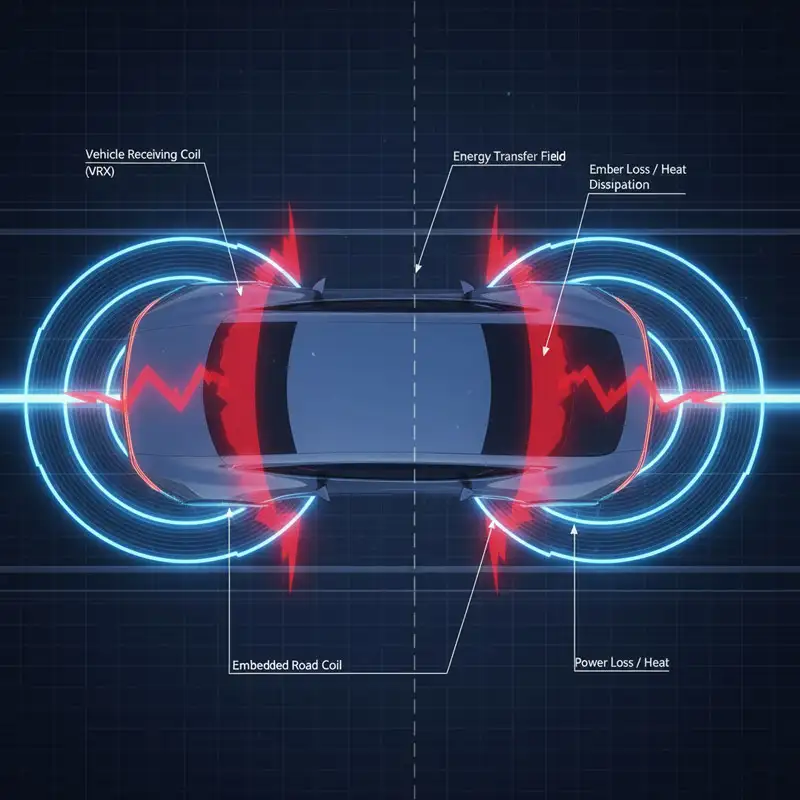
The core of wireless charging lies in Inductive Coupling Technology (IPT). This is a multi-step conversion process.
Ground Transmitter: The primary coil located underground converts grid power into high-frequency alternating current (AC).
Magnetic Field Generation: The high-frequency AC in the primary coil generates an alternating magnetic field.
Vehicle Receiver: The secondary coil at the bottom of the vehicle senses the magnetic field.
Current Generation: The secondary coil converts the sensed magnetic field back into electric current.
Onboard Conversion: The current is sent to the onboard receiver and converted into direct current (DC) required by the battery.
Interoperability is key to wireless charging. All charging pads and vehicles must “understand each other.”
Industry Challenge: The lack of a unified standard was the biggest obstacle to the widespread adoption of wireless charging in the past.
SAE J2954’s Promotion: The SAE J2954 Standard defines the safety thresholds, efficiency, and frequency of wireless charging systems.
Forward-Looking Choice: Priority should be given to selecting equipment that complies with the J2954 standard. This ensures compatibility and future investment protection.
There is a fundamental difference between the two technologies in the path of energy transfer from the grid to the battery. Understanding the path difference is the basis for evaluating charging efficiency loss.
Wired charging has the shortest path and the lowest loss.
AC Path: Grid AC -> Cable -> Onboard Charger (AC/DC Conversion) -> Battery.
DC Path (DCFC): Grid AC -> Charging Pile (AC/DC Conversion) -> Cable -> Battery.
Conclusion: Fewer conversion steps, with energy loss mainly occurring at the cable and connector contact points.
The wireless charging path is complex, involving multiple conversions and transmissions.
Conversion Steps: Grid AC -> Ground Transmitter (AC/AC Conversion) -> Magnetic Field (Energy Transfer) -> Onboard Receiver (AC/DC Conversion) -> Battery.
Loss Factors: Heat loss occurs during each AC/AC and AC/DC conversion. Air gap transmission is also a fixed source of loss.
The cost difference resulting from energy loss must be monitored.
Accumulation of Loss: An additional 5% to 10% energy loss results in significant cost accumulation for fast-charging stations serving hundreds of vehicles daily.
Pricing Strategy: This loss must be factored into operating expenses (OpEx). This will affect the final charging service pricing.

Efficiency affects profit, and speed affects customer turnover. These are core considerations for Return on Investment (ROI).
Wired Advantage: The overall efficiency of Level 3 DCFC systems can easily exceed 95%. This is an industry benchmark.
Wireless Challenge: Wireless charging efficiency typically ranges between 85% and 92%. Poor alignment, high temperature, or foreign objects can further reduce efficiency.
Business Consideration: Every 1% loss in efficiency means an increase in electricity expenditure.
Wired charging currently maintains an absolute lead in power output.
Wired Speed: The fastest DCFC can reach 350kW or higher, adding hundreds of kilometers of range to an EV in 15–20 minutes.
Wireless Speed: Current commercial systems are typically limited to power outputs of 11kW (L2) to 50kW (DC). This is suitable for long-duration parking but not for quick replenishment.
DCFC Value: High speed ensures a high turnover rate for charging piles during peak hours. The ability to serve more customers directly equates to higher revenue.
Wireless Positioning: Wireless charging is currently not suitable as the main service for urban fast-charging stations; it is better suited for scenarios with long dwell times.
Investment decisions must be based on a comprehensive Total Cost of Ownership (TCO) Analysis. The model of high initial outlay but low long-term operational expenditure may be more attractive.
Wired Investment: Hardware and installation costs for charging piles are relatively fixed and lower. The supply chain competition is mature.
Wireless Investment: Hardware costs are significantly higher than wired systems. It requires expensive ground charging pads, vehicle receivers (if purchasing in bulk for fleets), and more complex communication systems.
Wired Maintenance: Operating costs include a larger proportion for replacing worn cables, connectors, and regular electrical inspections.
Wireless Maintenance: Maintenance costs are primarily focused on electronic component monitoring and software updates. The absence of physical plugging greatly reduces mechanical damage and human wear.
Advantage: The low O&M cost advantage of wireless systems can offset its higher initial investment over the long term.
A TCO model must be established to guide investment.
Model Inputs: Inputs include installation costs, projected efficiency loss, electricity costs, annual maintenance budget, and equipment lifespan.
Key Decision Point: If the low O&M costs of a wireless system can balance its high CapEx over 5–7 years, then it is a strategic investment worth considering.
This represents the biggest barrier to market penetration for wireless charging and must be understood in advance.
Core Limitation: Wireless charging can only be achieved if the vehicle is equipped from the factory with a secondary receiving coil and corresponding power electronics system.
Hardware Complexity: The receiver must be capable of processing high-frequency AC current and safely and efficiently converting it to DC current.
User Limitation: Wireless charging services are restricted to vehicles with integrated technology. This results in a smaller initial user base.
Risk Assessment: Investing heavily in wireless infrastructure when market-compatible vehicles are scarce can lead to idle investment.
Countermeasure: Operators must collaborate with major automotive OEMs or monitor the certification status of third-party receivers.
Safety and Warranty: Non-original, aftermarket wireless receivers may appear on the market.
Expert Advice: Service agreements should explicitly state that services are only provided to original or certified accessories that comply with the SAE J2954 standard. This avoids efficiency, safety, or warranty issues caused by third-party devices.

Safety is the cornerstone of providing charging services. Both technologies present their unique safety challenges.
Wired charging safety risks primarily center on human error and equipment wear.
Physical Risks: Cables being run over, connector damage, and the risk of users tripping over cables in public areas.
Electrical Risks: In adverse weather conditions, water intrusion into connectors or improper handling can pose electrocution risks.
The challenge of wireless charging lies in the technology itself.
EMF Concerns: Although systems compliant with the J2954 standard have EMF radiation levels well below safety thresholds, user apprehension about radiation still exists. Clear informational material must be provided to address these concerns.
Foreign Object Detection (FOD): Foreign object detection must be performed between the charging pad and the vehicle. If metal objects (such as coins or keys) are present, inductive charging can cause them to heat up rapidly, leading to fire risks. Equipment must be guaranteed to possess advanced FOD functionality.
Compliance Requirements: Investment in wireless charging equipment must be certified against the SAE J2954 standard.
Significance: J2954 not only ensures safety but also guarantees efficiency and interoperability. This is the “entry ticket” to the wireless market.
User experience is key to determining future market share. Wireless charging is transformative in terms of user experience.
The greatest value of wireless charging lies in its convenience.
Simple Operation: Users simply park in the designated space and charging starts automatically, without needing to get out of the vehicle.
Environmental Adaptation: Eliminates the inconvenience of handling cables in poor weather, resulting in high user satisfaction.
High Service Stickiness: This high level of convenience can increase user loyalty and usage frequency.
The convenience of wired charging is limited by the physical connection.
Time-Consuming Operation: Finding the charging port, opening the cover, and physically plugging and unplugging the cable adds to the user’s operational time.
Physical Demand: Operating heavy-duty cables can be difficult for the elderly or people with disabilities.
Premium Market: Wireless charging can be positioned as a differentiated premium service in commercial real estate and luxury apartment complexes, commanding a price premium.
Basic Service: Wired charging remains the fundamental service provided to the general public to meet basic range needs.
Future infrastructure should adopt a hybrid model to maximize returns.
Needs Positioning: Different geographical locations and customer segments have different needs.
Primary/Secondary Configuration: In urban centers with high turnover demands, prioritize Wired Level 3 Fast Charging. In parking lots or garages, utilize Wireless Level 2 as a supplementary and value-added service.
Value Segmentation: Segment services into “Basic Fast Service” (Wired) and “Premium Convenience Service” (Wireless).
Retention Effect: Wireless charging can help attract and retain high-value customers who are willing to pay a premium for convenience.
Bus Fleets: Vehicles use high-power wireless charging during short stops at termini, eliminating manual plugging and maximizing efficiency.
Airport Parking: Deploy Wireless Level 2 in long-term parking areas, offering a “park and charge full” worry-free service.
| Feature | 🔌 Wired Charging | ⚡️ Wireless Charging |
| Energy Efficiency | High (95%+), Minimal Loss | Medium (85% – 92%), Conversion Loss Exists |
| Initial Investment | Low to Medium, Mature Infrastructure | High, Complex Equipment and Installation |
| Maintenance Cost | Medium to High, Connector Wear and Tear | Low, No Physical Contact Wear |
| Compatibility | Extremely High, Adaptable to all EVs (Connector Required) | Low, Limited to EVs with Built-in Receivers |
| Maximum Speed | Extremely Fast (Up to 350kW+) | Medium Speed (Currently <50kW Mainstream) |
| Convenience | Low, Requires Manual Plugging/Unplugging | Extremely High, Stop-and-Charge, Automatic Start |
| Best Scenario | Public Fast-Charging Stations, Long-Distance Travel | Autonomous Fleets, Premium Property Parking |
| Safety Concerns | Physical Tripping, Electrical Operation Risk | EMF Radiation, Alignment, Foreign Object Detection (FOD) |
A: Studies indicate that as long as the wireless charging system complies with industry standards (such as SAE J2954), its impact on battery life is similar to that of high-quality wired charging. Battery longevity primarily depends on temperature management and depth of charge, not the method of energy transfer.
A: Dynamic wireless charging is currently in the testing phase in several cities globally (such as Detroit and Sweden). Its large-scale commercial deployment still needs to overcome challenges like technology (high efficiency, long-distance transfer) and high infrastructure costs. It is projected to take another 5 to 10 years before it can be initially applied to public roads.
A: Modern wireless charging systems feature advanced FOD technology. They use sensors and algorithms to detect if metal, plastic, or other foreign objects have accidentally entered the charging zone. If detected, the system immediately stops or delays charging to prevent overheating or damage. Operators must ensure regular calibration and software updates.
A: While third-party add-on solutions exist on the market, relying on them is generally not recommended. Non-original or non-certified accessories can lead to extremely low efficiency, jeopardize the vehicle’s warranty, or pose safety risks. Operators should primarily focus on serving vehicles that have original, built-in wireless charging capabilities.

Wireless charging holds an important strategic position in the future transportation ecosystem. For autonomous fleet operators, wireless charging is indispensable. This is because autonomous vehicles, such as robotaxis and logistics unmanned vehicles, must achieve automatic energy replenishment without human intervention. Operators should acquire and accumulate wireless charging deployment experience before the large-scale commercialization of autonomous driving.
Furthermore, dynamic charging technology presents enormous potential. This concept allows electric vehicles to charge directly on specific roads while driving (Charging While Driving). This will not only completely eliminate range anxiety for users but may also prompt future electric vehicles to carry smaller, lighter batteries. Therefore, operators need to closely monitor national and local government pilot projects for dynamic charging roads and actively prepare to participate in early infrastructure investment.
In the long run, continuous R&D investment and technological planning are necessary. Operators must focus on technological advancements in wireless charging such as power enhancement, efficiency optimization, and foreign object detection. Treating wireless charging as a strategic asset is a key bargaining chip for securing large B-side contracts, such as urban public transportation and logistics fleets, over the next decade.
Authoritative Sources
SAE International: Latest Edition of SAE J2954 Standard for Wireless Power Transfer
U.S. Department of Energy (DOE): Analysis of Electric Vehicle Charging Infrastructure Costs and Deployment
WPT Technology Review: Comprehensive Review of Inductive Power Transfer Technology for Electric Vehicle Charging
BloombergNEF: Global Electric Vehicle Outlook and Charging Infrastructure Forecast
IEEE Xplore: Efficiency and Misalignment Tolerance in Dynamic Wireless EV Charging Systems
We will send detailed technical info and quotation to you!