Before starting your budget, businesses need to answer several key questions:
Are they for employees, customers, or fleets? Retailers may aim to attract customers, while logistics companies might prioritize fleet support.
According to U.S. Department of Energy data, the daily usage rate of charging stations in commercial settings ranges from 20% to 50%, depending on location and industry.
A parking lot might require 2-5 charging points initially, but this could increase to 10 or more in the future.
For example, a shopping center might need 4 charging points to meet current customer demand. However, considering the EV adoption rate grows by approximately 30% annually (IEA data), it’s wise to plan for an expansion to 8 points. Defining your needs is the foundation of budgeting, preventing increased costs later due to inadequate planning.
The type of charging equipment directly impacts your budget. Common options include:
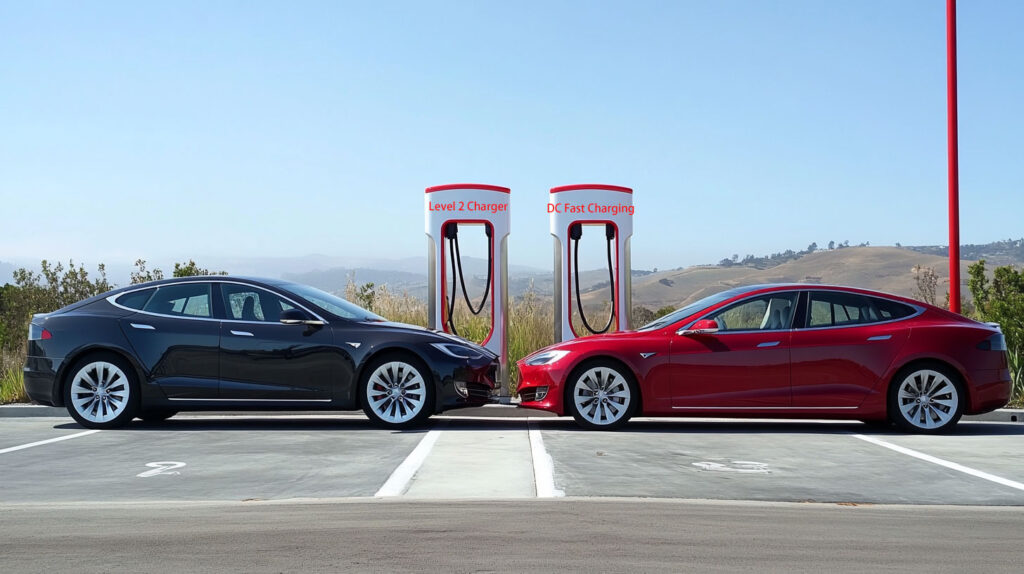
Uses a standard 120V power supply, suitable for low-usage scenarios, costing about $500-$1,000 per unit, but takes 8-12 hours to charge.
Uses a 240V power supply, ideal for commercial settings, costing $2,000-$5,000 per unit, with a charging time of 4-6 hours.
Offers rapid charging for high-traffic areas, costing $20,000-$50,000 per unit, with a charging time of 20-40 minutes.
Budget Recommendations:
Most businesses opt for Level 2 charging due to its cost-effectiveness. U.S. Department of Energy data shows Level 2 equipment accounts for over 70% of commercial charging stations.
Choose equipment with dual ports or modular designs for easy upgrades. For instance, installing Level 2 chargers that support future DC fast-charging expansion can save replacement costs later.
Installation fees can be a hidden major expense, influenced by the following factors:
Cost-Saving Tips:
For example, a small business with 10 parking spaces might spend $15,000-$25,000 on installation. Future expansions can reuse existing wiring, reducing additional costs.
The long-term operational costs of charging infrastructure cannot be overlooked:
Future-Proof Strategies:
Government and institutional support can significantly reduce budget pressure:
Recommendation: Check with local utility companies or government websites in advance to confirm available incentives. For instance, a $50,000 project could drop to $35,000 with subsidies, greatly improving ROI.
The key to future-proofing lies in scalability:
According to BloombergNEF (BNEF), EVs are projected to account for over 50% of global vehicle sales by 2040. Proactive planning prevents frequent upgrades due to outdated EV Charging Technology or insufficient capacity.
Combining the above steps, a typical commercial charging infrastructure budget might look like this:
Budgeting for EV Charging Infrastructure represents a strategic commitment to the future of transportation. Successful deployment hinges not only on hardware but also on investment in smart load management and long-term operational reliability. This guide has clarified all cost elements in commercial deployment, with smart management software being the core driver of cost-efficiency and scalability. To transform your EV Charging Infrastructure from a cost center into a potential revenue stream, you must look beyond basic installation and embrace a complete intelligent ecosystem.
Yes, EV charging infrastructure is significantly improving. Globally, the number of charging points continues to grow, and technology is advancing with faster charging, better compatibility, and simpler payment systems. Many countries and regions are investing heavily, such as the U.S. National Electric Vehicle Infrastructure (NEVI) program, aimed at expanding the network and boosting reliability.
Despite progress, EV charging infrastructure faces multiple barriers:
China currently leads globally in EV charging infrastructure. It boasts nearly two-thirds of the world’s charging stations, with a vast number of public and fast chargers. Norway also excels in per capita charging points and EV adoption. The Netherlands is a frontrunner in Europe for its high density of public slow chargers.
EV charging infrastructure is forecasted for significant growth. Market projections indicate an exponential increase in charging points globally by 2030 to meet the rising number of EVs. DC fast charging technology will continue to advance, and both private and public investments are expected to surge to alleviate “range anxiety” and support global sustainability goals.
In the United States, California is generally considered the state with the best EV infrastructure, boasting the highest number of public charging stations and longest charging corridors. Additionally, Vermont stands out for its high number of chargers per capita, while Massachusetts, Colorado, and Oregon also rank highly for their robust charging networks and EV-friendly policies.
We will send detailed technical info and quotation to you!