As EV adoption soars, charging station operators face a critical challenge: skyrocketing electricity bills and costly grid upgrades. The sudden, high-power demand from fast chargers can cripple local grids and incur exorbitant demand charges. This is precisely why EV energy storage systems (BESS) are no longer an option, but the cornerstone of next-generation charging infrastructure.
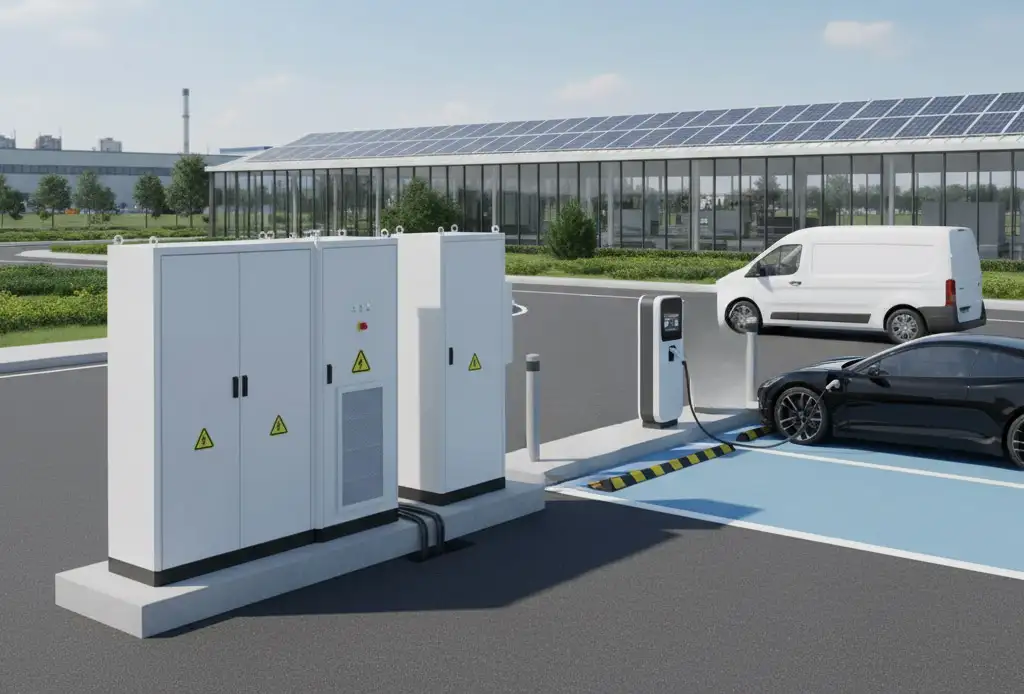
Definition: BESS (Battery Energy Storage System) refers to advanced systems that temporarily hold electricity to power electric vehicle (EV) chargers.
Function: It acts as a powerful, smart battery that buffers the power supply, whether from the main electricity grid or a renewable source like solar panels.
Process: The system stores energy in advance and releases it quickly to provide a steady, strong power flow for charging.
Importance: This is crucial for handling the high and sudden power demands of modern EV chargers, especially fast chargers.
Application: These systems are often contained within a dedicated energy storage container, making them a self-sufficient unit ready for deployment.
The operation of on-site energy storage revolves around managing the flow of electricity efficiently. The core principle is to “time-shift” energy use – storing it when it’s plentiful or cheap, and releasing it when it’s most needed or expensive.
Storing Energy: The BESS charges its batteries using electricity from the grid during off-peak hours or from on-site renewable sources like solar panels.
Releasing Energy: When an EV plugs in, the BESS discharges its stored energy. This prevents a sudden, massive load on the grid and avoids high demand charges.
Smart Control: An intelligent Energy Management System (EMS) acts as the brain, monitoring grid conditions, prices, and charging needs to optimize the timing of charging and discharging.
When talking about Grid-Connected Energy Storage systems, several important numbers help us understand their capabilities and how well they perform. These metrics are vital for assessing their efficiency and suitability for different charging needs:

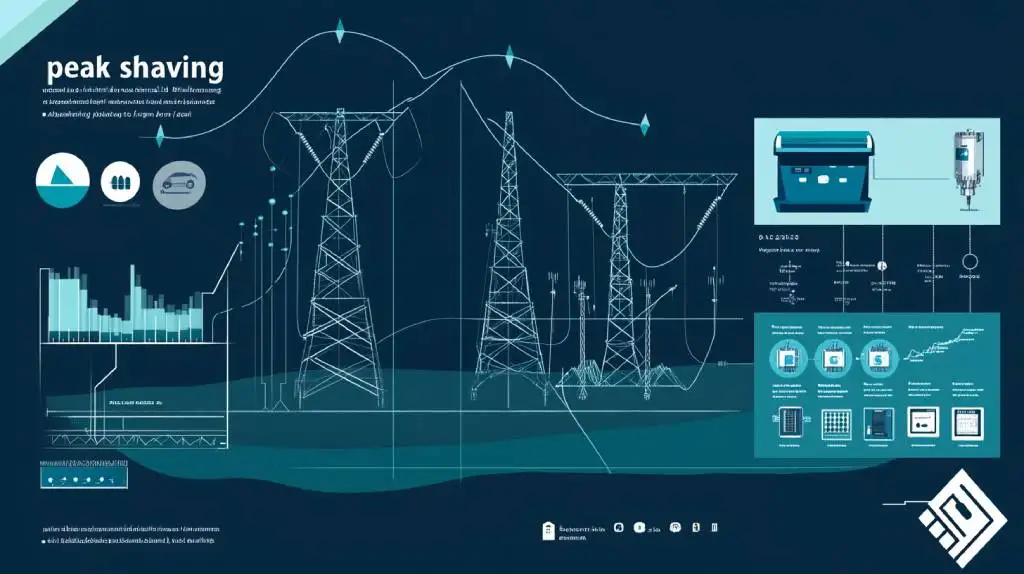
Mitigating Grid Impacts and Peak Shaving: High-power EV charging creates significant demand spikes that can stress local grids. BESS draws power during off-peak hours when electricity is cheaper. It then discharges this stored energy during peak times, a process known as “peak shaving.” This reduces the strain on the grid and lowers costs for charging station operators.
Enabling Faster Charging Speeds: Ultra-fast charging often requires prohibitively expensive grid connections. On-site BESS overcomes this limitation by delivering bursts of high power to an EV from its stored reserves. This allows charging stations to offer fast charging speeds even in locations with weaker grid infrastructure.
Seamless Integration of Renewable Energy Sources: BESS is essential for integrating intermittent renewable sources like solar and wind. Solar panels can charge the BESS during the day. The stored solar energy can then power EV charging after sunset or on cloudy days, making the process truly green and reducing reliance on fossil fuels.
Providing Grid Services and Revenue Opportunities: Beyond supporting charging, BESS can provide valuable services to the grid. By participating in demand response programs or providing voltage support, these systems can generate revenue for their owners. This transforms charging stations into active participants in grid stability.
Resilience and Off-Grid Capabilities: In areas with unreliable power, BESS solutions provide critical resilience. They can enable off-grid charging, ensuring essential services or remote communities have access to EV charging during outages. This is particularly vital for fleet depots or public stations that need uninterrupted service.
The efficacy of Charging Hub Battery Support hinges on the underlying technologies and how they are integrated. While various storage technologies exist, lithium-ion batteries currently dominate the market for EV charging applications due to their balance of energy density, power output, and declining costs.
Lithium-ion batteries are the workhorse of modern Battery Energy Storage Systems (BESS) for EV charging. They are characterized by:
These systems are often deployed as a self-contained Battery energy storage system container (BESS), offering a modular and scalable solution for various charging scenarios, from individual fast chargers to large-scale charging depots.
For applications demanding both high energy and high power, Hybrid Energy Storage Systems (HESS) combine different storage technologies. A common pairing involves lithium-ion batteries (for energy) with supercapacitors (for power).
Central to any Charging Infrastructure Battery Backing solution are sophisticated power electronics and an intelligent Energy Management System (EMS).
| Technology | Key Characteristics | Advantages | Disadvantages | Suitability for EV Charging |
|---|---|---|---|---|
| Lithium-ion BESS | High energy & power density, declining costs | Versatile, scalable, mature technology | Thermal management, degradation over time | Primary choice for most EV charging ESS |
| Supercapacitors | Very high power density, rapid charge/discharge | Long cycle life, instant power delivery | Low energy density, high self-discharge | Ideal for hybrid systems with batteries (HESS) for peak power |
| Flow Batteries | Scalable energy, long duration, decoupled power/energy | Long life, no self-discharge, safer | Lower power density, larger footprint | Emerging for long-duration charging depots where space isn’t an issue |
| Flywheels | Mechanical storage, high power, very fast response | Extremely long cycle life, high efficiency | Limited energy capacity, mechanical complexity | Niche for very high-power, short-duration grid stabilization or specialized fast charging |
The versatility of EV Charging Off-Grid Power allows for various deployment models, each tailored to specific needs and scales.
This is perhaps the most visible application. Public fast charging stations, often located along highways or in urban centers, face significant peak power demands. Integrating a Battery energy storage system container (BESS) allows these stations to offer consistent, high-speed charging without expensive grid upgrades. This reduces demand charges for operators and enables quicker installations. A notable example is Electrify America’s deployment of BESS at several of its charging stations in the US, enhancing grid resilience and charging availability.
For commercial fleets (buses, delivery vans, taxis), centralized charging depots can present enormous load demands, especially during nighttime charging. Large-scale Energy Storage Banks can manage this load, optimizing charging schedules, leveraging off-peak electricity, and integrating with renewable energy sources to power the entire fleet. This is critical for fleet operators aiming to reduce operational costs and meet sustainability targets.
While less common for individual homes due to current cost-effectiveness, the integration of smaller Battery storage EV charger units with home solar and Energy Storage Banks is an emerging trend for prosumers. For workplaces, shared Energy storage container solutions can manage charging for multiple employee EVs, reducing peak demand for the facility.
In situations where grid access is limited or nonexistent, or for emergency charging needs, mobile Energy storage container units can provide temporary or off-grid EV charging. These self-contained units can be deployed quickly to events, disaster zones, or construction sites, demonstrating the flexibility and independence offered by Energy Storage Systems.
Despite the immense benefits, the widespread adoption of Energy Management for Charging Stations faces several hurdles, alongside promising trends and policy developments.

In the EU and the US, governments and utilities are introducing incentives to promote the deployment of Grid-Scale EV Charging Buffer
The future of EV Charging Power Banks is bright and interconnected. We anticipate:
Continued advancements in battery technology and manufacturing scale will further drive down the cost of Battery Energy Storage Systems and Battery storage EV charger solutions, making them ubiquitous.
EVs themselves, equipped with bidirectional charging capabilities, can become mobile Energy Storage Banks, potentially feeding power back to the grid during peak demand or acting as emergency power sources. This transforms the EV from a consumer into a dynamic grid asset, powered by sophisticated Battery Energy Storage for Electric Vehicle Charging Stations technology.
AI-powered EMS will become even more sophisticated, enabling predictive optimization based on weather forecasts, grid conditions, and user behavior, maximizing the efficiency and profitability of Energy storage container deployments.
As storage costs decrease, more EV charging will be powered directly by on-site or nearby renewable energy, leading to a truly zero-emission transportation system.
A Cornerstone of the Future: The rapid growth of EVs requires a robust and sustainable charging infrastructure. Stationary energy storage is not just an enhancement; it is the fundamental cornerstone for this future.
Transforming the Landscape: Battery Energy Storage Systems (BESS) are transforming electric mobility by mitigating grid stress and enabling ultra-fast charging. They also help to integrate renewable energy sources and provide valuable grid services.
Indispensable Component: As costs continue to decline, BESS will become an indispensable component of EV charging stations. This will accelerate the world’s transition to a cleaner, more electrified transportation future.
Electric vehicles (EVs) can be used as energy storage devices primarily through Vehicle-to-Grid (V2G), Vehicle-to-Home (V2H), and Vehicle-to-Load (V2L) technologies. These systems enable bidirectional power flow, meaning the EV’s battery can not only receive electricity for charging but also discharge stored energy back to the grid, power a home, or supply power to external appliances. This functionality transforms EVs into mobile Energy Storage Banks, contributing to grid stability, offering emergency power, and potentially generating revenue for owners.
For optimal battery health and longevity, an EV’s charge level for storage (especially when participating in V2G or V2H services) should typically be maintained within a range, often between 20% to 80% State of Charge (SoC). This avoids the stress of frequently charging to 100% or discharging to near 0%. When providing grid services, users would typically set a minimum discharge limit (e.g., leaving at least 20-50% charge) to ensure sufficient range for their next journey.
Energy management for EV charging refers to the intelligent optimization of power flow to and from Electric Vehicles and their charging infrastructure. It involves using Energy Management Systems (EMS) and smart charging technologies to control when, how fast, and how much power an EV receives or discharges. Key goals include reducing electricity costs (e.g., through peak shaving and off-peak charging), minimizing grid strain, maximizing the integration of renewable energy sources, and preserving EV battery storage longevity.
Energy in an electric car is primarily stored in a Lithium-ion Battery Pack. This pack consists of numerous individual battery cells grouped into modules, which are then assembled into a larger unit. Within each cell, electrochemical reactions occur, where lithium ions move between a positive electrode (cathode) and a negative electrode (anode) through an electrolyte. When the car is charging, ions move in one direction, storing energy; when the car is discharging (powering the motor), they move in the opposite direction, releasing energy. A sophisticated Battery Management System (BMS) monitors and controls this process for safety and efficiency.
The term EV battery storage can refer to two main concepts:
International Energy Agency (IEA) – Global EV Outlook:
National Renewable Energy Laboratory (NREL) – EV Charging Infrastructure and Storage:
BloombergNEF (BNEF) – Battery Price Survey / Energy Storage Outlook:
U.S. Department of Energy (DOE) – Infrastructure Investment and Jobs Act (IIJA) & Inflation Reduction Act (IRA):
European Commission – Fit for 55 Package & Sustainable Transport Policy:
Electrify America (Case Studies/Press Releases):
We will send detailed technical info and quotation to you!