Do you need a surge protector for your EV charger? The answer is a definitive YES.
EV Charger Surge Protection is not just a recommendation; it is essential for safeguarding your investment. Installing a Type 2 surge protection device (SPD) serves as a one-time insurance policy that delivers three key benefits:
Risk Mitigation: It prevents unexpected voltage spikes from damaging your EV’s delicate Onboard Charger (OBC) and Battery Management System (BMS).
Cost Savings: It avoids thousands of dollars in repairs compared to a small upfront installation cost.
Full Coverage: It protects both your Electric Vehicle Supply Equipment (EVSE) and the sophisticated electronics inside your car.
A power surge can silently destroy your expensive Electric Vehicle Supply Equipment (EVSE) in an instant. In a worst-case scenario, the damage extends straight to your vehicle.
Instead of worrying about catastrophic electrical events, this guide will walk you through exactly how to secure your setup:
Which Type to Get: Identifying the right SPD for your specific charger.
The Cost Reality: What you should expect to pay for proper protection.
Peace of Mind: How to ensure your charging ecosystem is safe 24/7.
This isn’t about upselling you on something you don’t need. The 2020 and 2023 NEC updates have specifically expanded requirements for surge protective devices (SPDs) in homes, proving their necessity.
Why the urgency? Your Level 2 home EV charger is one of the most powerful appliances you own. It handles high-voltage loads while containing highly sensitive electronic components, making panel-level protection more critical than ever.

A power surge is a brief, intense spike in your home’s electrical voltage. Imagine the water pressure in your pipes suddenly blasting to ten times the normal level for a split second. That’s what a power surge does to your wiring. It can fry sensitive microprocessors and circuit boards in an instant.
Most people think of lightning when they hear “power surge.” While lightning is a major cause of catastrophic surges, it’s far from the only one. According to the National Electrical Manufacturers Association (NEMA), about 60-80% of power surges are generated inside your home.
Internal Surges: These happen when large appliances with motors, like air conditioners or refrigerators, cycle on and off.
External Surges: These come from outside the home. They can be caused by utility grid switching, downed power lines, or nearby industrial operations.
Lightning: This is the most powerful and destructive type of surge, capable of overwhelming most standard electronics. Even a distant strike can induce a powerful surge into utility lines.
Your EV charger, or EVSE, is not a simple extension cord. It is a complex piece of equipment filled with circuit boards that communicate with your vehicle. The onboard charger and Battery Management System (BMS) in your car are even more sensitive and expensive.
A significant power surge can lead to:
Complete EVSE Failure: Your charger simply stops working, requiring a replacement that can cost between $500 and $1,000.
Degraded Performance: A series of smaller surges, as noted by the Insurance Institute for Business & Home Safety, can degrade electronic components over time, leading to premature failure.
Catastrophic Vehicle Damage: In the worst cases, a surge can travel through the charger and damage the car’s onboard charging unit or BMS. A repair like this can easily run into the thousands of dollars.
A surge protector acts not as a wall, but as an incredibly fast and smart safety valve for your home’s electrical system. Its primary job is to divert, not block, dangerous excess voltage.
Think of it like a pressure relief valve on a boiler. Under normal conditions, the valve is closed, and electricity flows past it to your EV charger without interruption. Inside the surge protector is a key component called a Metal Oxide Varistor (MOV). Normally, the MOV has very high resistance. But when a voltage spike occurs, the MOV’s resistance instantly drops to nearly zero in a matter of nanoseconds.
Most people blame lightning, but the reality is closer to home. Internal sources actually account for 60-80% of all power surges.
These aren’t rare events; they happen daily from common triggers like major appliances (A/C, refrigerators) cycling on and off, or routine power grid switching by your utility company.
A surge protector acts not as a wall, but as an incredibly fast safety valve for your home’s electrical system.
Under normal conditions, electricity flows to your EV charger without interruption. But when a voltage spike hits, the protector acts instantly. The massive surge energy is quickly diverted to the grounding system and dissipated harmlessly.
This means your sensitive EV charger never feels the dangerous overvoltage because the protector neutralizes the threat before it can cause damage.
Understanding the different types of surge protection is key to making the right choice. The industry categorizes Surge Protective Devices (SPDs) into “Types,” which define where they are installed and what level of protection they offer.
For protecting a high-power device like an EV charger, the only truly effective solution is a whole house surge protector for ev charging. This device is installed directly in or next to your home’s main electrical panel, acting as a gatekeeper for all the power entering your house.
Understanding the difference between “Type 1” and “Type 2” devices is the key to picking the right protection. Here is the breakdown based on where they live and what they protect.
Installation Location: Installed on the “Line Side” (between the utility pole and your electricity meter).
Best For: Battling massive external surges like direct lightning strikes on power lines.
Home Use: Typically installed by utility companies. Not the standard DIY solution for homeowners.
Installation Location: Installed on the “Load Side” (directly inside or next to your breaker panel).
Best For: Protecting all circuits in your house—including your EV charger—from both external spikes and internal switching surges.
Home Use: This is the gold standard for residential EV charging. It stops surges right at the panel before they reach your car.
This is the best surge protector for home ev charger because it shields the dedicated 240V circuit the charger runs on. When a surge event occurs, the Type 2 SPD diverts the excess voltage safely to the ground wire before it can travel to your charger and vehicle. As stated by experts at the Electrical Safety Foundation International (ESFI), layered protection starting at the service panel is the most effective strategy.
A Type 3 SPD is the familiar surge protector power strip you plug your computer or TV into. While useful for those devices, they are completely inadequate for a 240V, high-amperage EV charger. Most are not rated for that voltage, and they offer no protection for hardwired chargers. For a plug-in NEMA 14-50 charger, a Type 3 device offers minimal protection and should never be used as the only line of defense.
Many high-quality EV chargers advertise “built-in surge protection.” While this is a useful feature, it is limited to handling only minor voltage fluctuations.
Internal protection is not capable of withstanding the powerful, high-energy surges caused by storms or grid switching. It should never be your only safeguard.
Instead, you must install a Type 2 whole-house SPD to act as your primary line of defense. It absorbs the heavy hits at the breaker panel, ensuring that massive voltage spikes are neutralized before they ever reach—and overwhelm—your charger’s internal components.
| Charger Type | Power Output | Charging Time | Best For |
|---|---|---|---|
| Level 1 | 1.4 kW | 8-20 hours | Home charging overnight |
| Level 2 | 7-19 kW | 3-8 hours | Home, workplace, public parking |
| DC Fast | 50-350 kW | 20-60 minutes | Highway stations, fleets |
The right approach depends on your EV Charging Station Design.
For Hardwired EV Chargers:
If your charger is wired directly into the wall without a plug, follow this 4-step protocol to secure it:
Confirm Connection: Verify that your EV charger connects directly to a dedicated circuit breaker on your main panel.
Select Protection: Purchase a Type 2 Whole-House SPD. Ensure it matches your panel’s brand or is a universal fit (like those from Leviton or Eaton).
Book a Pro: Contact a licensed electrician. Since installation involves working inside the main live panel, this is strictly not a DIY job.
Verify Status: After installation, check the SPD’s faceplate. Ensure the LED indicator lights are Green (or On), confirming that active surge protection is live.
For Plug-in (NEMA 14-50) EV Chargers: The best practice is still a Type 2 whole-house surge protector. This protects the outlet and everything else in your home. You can add a specialized, high-quality Type 3 surge protector at the outlet, but it should be seen as a secondary, not primary, layer of defense.
When choosing a device, stick with reputable electrical equipment manufacturers. Their products are rigorously tested and adhere to strict EV Charging Standards for safety and reliability.
Leviton: A leader in residential electrical products, offering a wide range of well-regarded SPDs.
Eaton: A global power management company with a strong reputation for robust surge protection.
Siemens: Another industry giant known for high-quality circuit breakers and electrical panel components.
Schneider Electric (Square D): A top choice for homeowners, especially if you already have a Square D electrical panel.
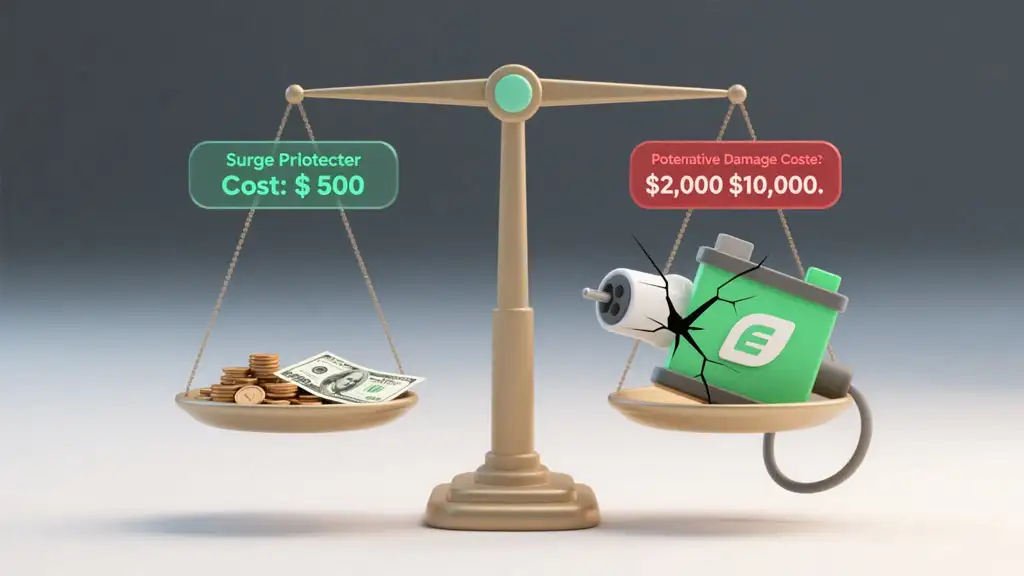
Absolutely. Let’s do a simple cost-benefit analysis. The charging station cost is already significant, so protecting it is a logical next step.
The total cost has two parts: the device itself and the labor for professional installation. This is not a DIY job. The NEC and all safety organizations state that work inside a main service panel must be done by a qualified, licensed electrician.
Device Cost: A high-quality Type 2 SPD from a top brand typically costs between $100 and $300.
Professional Installation Cost: An electrician will likely charge between $200 and $500 for the installation, which usually takes about one to two hours. This can vary based on your location and the complexity of your panel.
Total Estimated Cost: $300 – $800
Now, let’s compare that one-time investment to the potential costs of a surge event without protection.
Cost to Replace a Level 2 EV Charger: $500 – $1,000+
Cost to Repair/Replace Car’s Onboard Charger: $2,000 – $7,000+
Cost to Repair/Replace Battery Management System: $3,000 – $10,000+
For a one-time cost of a few hundred dollars, you protect against potential repairs costing ten to thirty times more.
This small upfront investment acts as a crucial safeguard for your major asset, ensuring longevity even as EV Charger Technology Trends make these charging systems increasingly complex and expensive to replace.
No. A properly installed, UL-listed SPD will not void any warranties. In fact, some manufacturers may look more favorably on claims if you can show you took steps to protect the equipment.
Yes. As we covered, most surges are generated internally or by the utility grid. Protection is necessary everywhere, regardless of climate. This is especially true when considering challenges like Extreme Cold EV Charging Solutions, where grid stability can be a factor.
Mostly, yes. SPDs are designed to handle many small surges over their lifetime. However, after diverting a very large surge (like a nearby lightning strike), the device may sacrifice itself and need replacement. Most modern SPDs have an LED indicator light that shows you if it’s still functioning. The U.S. Department of Energy recommends checking these indicators periodically.
Unplugging only during storms is impractical and misses the majority of internal surges; whole-house protection offers a long-term, hands-free solution.
The connector type (J1772, NACS/Tesla) doesn’t affect the need for surge protection. The protection happens at the electrical panel, long before the power ever reaches the connector. All types of Level 2 chargers require the same level of protection at the source.
Installing a whole-house surge protector is a fundamental component of modern home electrical safety.
It is not a luxury, but a standard requirement for any home equipped with high-power EV charging infrastructure. This simple addition ensures your electrical system is robust enough to handle the demands of modern technology.
The question is not if a power surge will happen, but when. For a relatively small, one-time investment, you buy robust protection and lasting peace of mind. You ensure that your EV and your charger are safe from the invisible, ever-present threat of power surges.
Don’t wait for a costly failure to prove the point. Contact a qualified electrician today and ask about installing a Type 2 whole-house surge protector. It’s the smartest, simplest, and most effective way to safeguard your EV charging ecosystem for years to come.
Authoritative Source
National Electrical Code® (NEC) Requirements Related to Surge
Home Surge Protective Devices
About NEMA Surge Protection Institute
From initial consultation to seamless installation, our expert team delivers custom EV charging solutions tailored to your business needs.
We will send detailed technical info and quotation to you!