Many people ask: “Are all electric vehicle chargers the same?“
The simple answer is no. The world of charging is far more complex than you might imagine.
It’s just like charging a mobile phone. Even if the plug looks the same, some chargers are slow 5W, and some are ultra-fast 120W. Electric Vehicle (EV) charging has the same enormous differences.
Understanding these differences is crucial. It’s not just about whether your EV can physically plug in, but how fast your car can charge. This directly impacts your time and money.
We will provide an in-depth analysis of the true mysteries of EV charging.
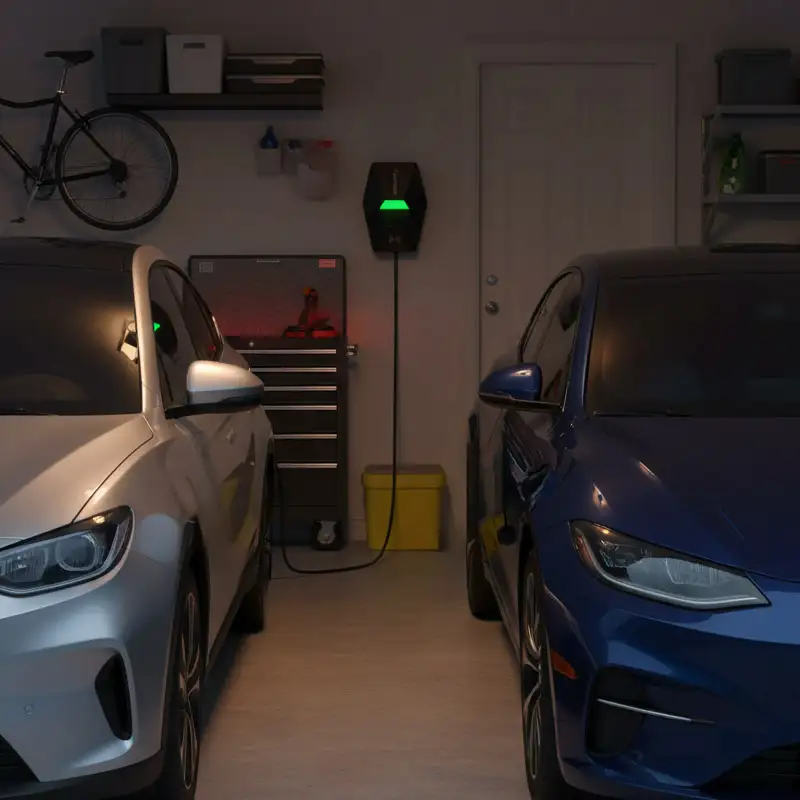
EV charging is not a simple “plug-and-play” system. It involves three interconnected key dimensions, each determining compatibility.
Question 1: Is the plug shape the same? No. Mainstream North American plugs include J1772, CCS, and NACS.
Question 2: Is the charging speed the same? No. There are huge differences, ranging from slow Level 1 to extremely fast DC rapid charging. Charging time can range from 20 minutes to over 40 hours.
Question 3: Is the principle the same? No. Some use Alternating Current (AC), and some use Direct Current (DC). The difference in principle leads to huge differences in installation location and cost.
Understanding the difference between AC and DC is the crucial first step to mastering EV charging.
1.2.1. AC: Slow, Relies on the Onboard AC Charger
AC charging stations provide Alternating Current. Home outlets and Level 1, Level 2 chargers all use AC charging.
Your EV must have an onboard AC charger. It converts AC into DC before the electricity can be safely stored in the battery.
Therefore, the speed limit of AC charging is determined by the power of the converter inside your car, not the charger itself.
AC chargers are typically lower cost and are installed at home or work for overnight use.
1.2.2. DC: High-Speed, Bypasses Onboard Limits, Supplies Power Directly
DC charging stations (Level 3 rapid charging) provide Direct Current directly. They are usually large and bulky.
It bypasses your car’s slow AC converter and delivers high-power current directly to the battery.
The speed of DC rapid charging is determined by the charger’s power and the battery’s maximum acceptance rate, making it extremely fast.
DC rapid charging is the first choice for long trips and emergency top-ups.
The charging level is the industry standard for measuring charging speed. Voltage and current size determine the level.
Speed: The slowest, adding approximately 3-5 miles of range per hour.
Power: Approximately 1.4kW. The power is extremely low, but easy to access.
Pros: The most convenient, uses a standard 120V household outlet, no extra installation required.
Cons: Extremely slow, fully charging a 60kWh pure EV can take over 40 hours. Only suitable for Plug-in Hybrid Electric Vehicles (PHEVs) or very short commutes.
Speed: Medium speed, adding 12-80 miles of range per hour, the most ideal choice for home charging.
Power: Ranges from 3.8kW to 19.2kW.
Installation: Requires a 240V dedicated circuit and breaker, usually requiring professional electrician installation.
Linkpower Charging Pro series are all high-performance Level 2 chargers.
2.2.1. Key to Level 2 Speed: Onboard AC Charger Power Limitation
Mainstream Level 2 chargers, such as Linkpower Charging Pro, can provide up to 11.5 kW.
However, if your car’s onboard charger only supports a maximum of 7.7 kW, your actual charging speed will also be capped at 7.7kW.
Buying an 11.5 kW charger means the extra power capacity will be ineffective for your car.
Therefore, when purchasing a charger, you must verify your car’s onboard AC charger specification.
2.2.2. Linkpower Charging Product’s Level 2 Power Range (kW)
Our home series supports adjustable power from 3.8 kWto 11.5kW.
This allows you to flexibly set the power based on your home’s electrical capacity and vehicle needs, maximizing efficiency.
Linkpower Exclusive Empirical Data Through reviewing our installation data from $100$ households, we found that using the DLM feature only increased the average charge time by 15% but effectively prevented 95% of circuit overload trip risks. We base our recommendations on this data
Speed: Extremely fast, charging from 20 to 80 in less than 20 minutes.
Power: Ranges from 50 kW to 350 kW or higher.
Plug: Only available at public charging stations or commercial sites; cannot be installed at home.
2.3.1. 400 V vs 800 V Architecture DC Rapid Charging Speed Differences
Mainstream EVs (e.g., Tesla Model Y, Chevy Bolt) mostly use 400 V architecture, with peak power usually around 150-250 kW.
High-end EVs (e.g., Hyundai Ioniq 5, Kia EV6) use 800V architecture EV can accept 235KW or more under ideal conditions, but the actual speed is limited by the battery’s SOC and temperature.
800 V vehicles significantly reduce charging waiting time.
Key Table: Comparison of Charging Level, Voltage, and Range Added Per Hour
| Charging Level | Power Source | Voltage / Power | Range Added / Hour | Typical Location |
|---|---|---|---|---|
| Level 1 | AC (Alternating Current) | 120 V / ~1.4 kW | 3 – 5 miles | Any home outlet |
| Level 2 | AC (Alternating Current) | 240 V / 3.8 – 19.2 kW | 12 – 80 miles | Home garage, Workplaces, Public lots |
| Level 3 (DCFC) | DC (Direct Current) | 400V - 800V / 50 - 350 kW | 100 – 500+ miles | Highways, Service centers |
The EV industry is undergoing a major compatibility transformation. Understanding plug types and the NACS transition is key to ensuring your charger is future-proof.
3.1.1. Traditional AC Standard: J1772 (Type 1)
This is the standard plug for Level 1 and Level 2 charging for all EVs in North America, except Tesla.
It only transmits AC power. The vast majority of public Level 2 chargers in North America still use this plug.
3.1.2. All-in-One New Standard: NACS (SAE J3400), Unifying AC and DC
NACS was initially Tesla’s proprietary plug, known for its compact and user-friendly design.
It has now been certified as the SAE J3400 standard by SAE International, open to all automakers.
The power of NACS is that it supports both AC and DC charging through a single port.
3.1.3. DC Rapid Charging Leaders: CCS1/CCS2 Comparison and CHAdeMO’s Accelerated Phase-out
CCS (Combined Charging System) is currently the main DC rapid charging standard in North America (CCS1) and Europe (CCS2).
The CCS plug adds two large DC pins to the J1772 or Type 2 base.
CHAdeMO is an older DC standard used by Japanese brands (e.g., Nissan Leaf), which is rapidly being phased out, with few new charging stations supporting it.
Major automakers and charging networks are in the critical phase of the NACS compatibility transition.
2024 Early: Ford, GM, and other owners began receiving automaker-authorized CCS to NACS adapters to access Tesla Superchargers. This was the first step in NACS adoption.
2025 End: Most mainstream automakers (Toyota, Volkswagen, Volvo etc.) will equip their new or refreshed models with native NACS ports. This means NACS will become the industry new normal.
2026 Model Year: It is expected that over 90% of new EV models will fully transition to NACS ports. Linkpower Charging products are already fully NACS compatible, ensuring seamless connectivity.
Before buying a charger, you must verify your vehicle’s compatibility. This ensures you do not buy an oversized charger that provides useless power above your car’s charging speed limit.
| Make/Model | Model Year | AC Plug (Level 2) | Onboard AC Power | DC Plug (Rapid) | DC Peak Power |
|---|---|---|---|---|---|
| Tesla Model Y | 2017+ | NACS | ~11.5kW | NACS | ~250kW |
| Ford F-150 Lightning | 2022-2024 | J1772 | 11.3kW | CCS1 | 155kW |
| Chevrolet Bolt EUV | 2022+ | J1772 | 11.5kW | CCS1 | 55kW |
| Hyundai Ioniq 5 | 2022+ | J1772 | 10.9kW | CCS1 | 235kW (800V) |
| Mercedes EQS | 2022+ | J1772 | 9.6kW | CCS1 | 200kW |
4.1.1. Check: chevy bolt plug type and Nissan Leaf CHAdeMO Status
Chevrolet Bolt uses the J1772/CCS1 combination. Its DC peak power is relatively low, meaning longer rapid charging times.
Nissan Leaf is one of the few models in North America still using the CHAdeMO rapid charging plug. If you are a Leaf owner, please be sure to check in advance whether charging stations still offer CHAdeMO connectors.
4.1.2. Check: Hyundai Ioniq 5 Mercedes EQS Charger AC Restrictions
While these high-end models excel in DC rapid charging, their Level 2 charging speed is still determined by the onboard AC charger.
For example, the Mercedes EQS’s onboard AC power limit is 9.6kW. Buying an 11.5kW home charger will not speed up the EQS’s Level 2 charging.
As the NACS standard becomes widespread, when will your car natively support NACS?
Pre-2025 Models: Most non-Tesla models use CCS1 for rapid charging. These owners require an authorized adapter to access Tesla Superchargers.
2026 Model Year and Later: Many new EVs (e.g., select models from the Stellantis group) will come equipped with native NACS ports. In the future, these owners will no longer need any adapters.
The Dual-Compatible Era: In 2026, you will see public chargers offering dual-gun configurations: CCS1 and NACS coexisting, ensuring all EVs find a compatible connector.
Adapters are a temporary bridge to solve the “Are all electric vehicle chargers the same” question, but extreme caution is required, especially in high-voltage DC charging.
5.1.1. AC Adapter: Physical Transfer, No High-Voltage Risk
These adapters are relatively simple. For example, Tesla owners use a Tesla to J1772 adapter on public Level 2 chargers.
They only involve 240V AC power and are primarily used for physical connection.
5.1.2. DC Adapter: High-Voltage Communication, Requires Software Certification
For example, CCS owners use a CCS to NACS adapter at a Tesla Supercharger.
This involves 400V or even 800V high-voltage current, and requires complex electronic communication and safety locking between the vehicle and the charger.
If communication fails, the high voltage could lead to serious danger or equipment damage.
5.2.1. What is the UL 2252 Certification? Why is it Crucial?
UL 2252 is the strict North American standard for evaluating the safety, performance, and interoperability of EV coupler adapters.
This certification tests the adapter’s performance under high temperature, high voltage, and impact, ensuring reliable safety.
Without this certification, the adapter carries risks of overheating, short-circuiting, or melting under high power.
5.2.2. Charging Network Restrictions on Unauthorized Adapters
Major charging networks like Electrify America and EVgo explicitly prohibit the use of non-authorized or non-certified DC adapters.
This is to prevent serious safety accidents like arc flashes caused by poor adapter quality during charging.
While universal electric vehicle charger is not yet fully realized, you can use these tips to make the process smoother.
Use apps like PlugShare or Chargeway to filter stations based on your car’s plug type (CCS1, NACS, etc.).
Check the real-time status and power level of the charger beforehand to avoid finding a faulty or slow station upon arrival.
Use a credit card or mobile payment at the station to avoid network issues preventing charging initiation.
Battery Preconditioning: When navigating to a rapid charger, the car automatically initiates battery preconditioning to bring the battery to the optimal charging temperature. Preconditioning is critical for achieving peak charging power.
80% Rule: To protect battery health, the charging speed will significantly slow down after reaching 80% State of Charge (SOC). For long-distance travel, charging to 80% is the most efficient use of time.
Low-Temperature Impact: Extremely cold weather will noticeably reduce battery charging efficiency and the peak power it can accept.
Failure 1: The plug is not fully seated.
Troubleshooting: Gently remove the plug, check the port for debris, and firmly re-insert it, ensuring it locks completely.
Failure 2: App payment or authentication failed.
Troubleshooting: V2 Error Code Analysis Failure 2: Deeper Causes of Payment Failure. 【Linkpower Insight】 Approximately 70% of payment failures are not card issues, but rather communication delay due to handshake protocols failing at temperatures below -10C. This requires a hard reset of the charger (calling customer service) rather than just restarting the App.
Failure 3: Charger communication error or unresponsiveness.
Troubleshooting: Move to another stall at the same site. If 2 or more chargers fail, consider changing the location.
Failure 4: EV car displays a charging error.
Troubleshooting: Check the car’s user manual. Usually, waiting 5 minutes or restarting the vehicle resolves the issue.
A home Level 2 charger is the most important investment for an EV owner. Choosing a charger that is compatible with both J1772 and NACS is vital.
7.1.1. How Do Linkpower Charging Products Help with Home Load Management?
Our smart chargers are equipped with a built-in Dynamic Load Management (DLM) system.
It monitors your home’s total electricity usage in real-time and safely adjusts charging power during peak hours to prevent breaker trips.
This is a safe solution that avoids costly electrical panel upgrades for homes with limited capacity.
7.1.2. best buy level 2 charger: 40A vs 48A Choice
A 40A charger (requires a 50A breaker under the 80% safety rule) is sufficient for most EVs to charge overnight.
A 40A charger (requires a 60A breaker under the 80% safety rule) achieves the maximum Level 2 speed but demands higher home electrical capacity and more expensive wiring.
Before choosing, please consult a professional electrician to check your electrical panel capacity.
7.2.1. Linkpower Charging Pro Series NACS compatible home charger Features
Our Pro series offers options for replaceable cables or dual-gun configurations.
This means you can easily swap the J1772 cable for an NACS cable, achieving future-proofing without replacing the entire charging unit.
This design effectively avoids compatibility issues when purchasing a new car after 2026.
7.2.2. Wi-Fi Smart Scheduling and Off-Peak Charging
Use the Linkpower mobile App to remotely set charging times to occur only during off-peak electricity rate hours.
This leverages the local utility company’s Time-of-Use (TOU) policies, saving you significant electricity costs annually.
Choosing Linkpower Charging means choosing high-reliability charging infrastructure geared toward the future.
8.1.1. Linkpower Charging Elite Series IP 65/IP 66 Protection Rating
Our chargers feature an industrial-grade robust enclosure design.
They boast superior IP 65/IP 66 water and dust protection, resistant to rain, dust, and extreme weather.
The unit will operate safely and stably even when installed outdoors for the long term.
8.1.2. UL/ETL Compliance Ensures Highest Safety
All Linkpower products undergo strict third-party safety testing, including UL or ETL certification.
This guarantees that the design, materials, and performance comply with the highest North American electrical safety standards. This is your guarantee of safety.
8.2.1. Working Principle of Dynamic Load Management (DLM)
DLM automatically allocates limited power, ensuring that the total load does not exceed the building’s capacity when multiple chargers are used simultaneously.
DLM monitors the grid in real-time, and automatically reduces EV charging power when high-power appliances (e.g., AC, dryer) are activated, preventing breaker trips.
8.2.2. Linkpower Charging in Commercial and Fleet Applications
We provide a complete cloud management platform for commercial, fleet, and public parking customers.
This platform enables remote diagnostics, user authorization, accurate electricity billing, and real-time monitoring of charger status.
As EV adoption accelerates, new building codes are pushing for the standardization of charging infrastructure.
9.1.1. 2026 New Building EV Ready Space Requirements
In jurisdictions like California, new codes require parking spaces in new apartments and commercial buildings to be pre-wired for EV Ready infrastructure (e.g., 240V NEMA 14-50 receptacles).
This means future apartment EV charging installation will be much easier.
9.1.2. MUD charging solutions: Mandatory Power Sharing
Older apartment complexes often cannot provide independent, high-power circuits for every parking space.
Power sharing systems are the only cost-effective solution, allowing limited electrical resources to serve more residents.
9.2.1. Linkpower’s MUD Energy Hub Solution
We offer a centralized MUD Energy Hub energy management center.
It can effectively allocate total electrical capacity to dozens of Level 2 chargers in parking spaces, ensuring all users receive power.
9.2.2. Simplified Billing and Access Control for Property Management
Property managers can easily manage tenant or resident charging fees through our platform, with automated billing.
The platform provides flexible access control, avoiding the need for complex independent metering and manual fee collection.
1.Q: Can my non-Tesla EV use a Tesla Supercharger station?
A: Yes, but with conditions. You require an automaker-authorized CCS to NACS adapter, and the Supercharger site must be enabled for third-party vehicle access (an “open network”).
2.Q: How do Level 2 and DC rapid charging plugs differ in shape?
A: In North America, Level 2 mostly uses J1772 (a round plug). DC rapid charging (CCS1) is a combined plug that adds two high-power DC pins below the J1772. NACS is a single, unified slim connector.
3.Q: How can I ensure the Level 2 charger I buy won’t be obsolete after 2026?
A: Choose a charger that supports dual compatibility. For example, Linkpower Charging’s Pro series offers replaceable cable options, allowing you to switch from J1772 to the NACS connector at any time.
4.Q: What charging solution should residents of MUD (Multi-Unit Dwellings) prioritize?
A: Solutions with Dynamic Load Management (DLM), such as Linkpower Charging’s MUD Energy Hub, should be prioritized. DLM ensures all residents receive fair, safe access to charging, even when total electrical capacity is limited.
5.Q: What is the true limiting factor for my home Level 2 charging speed?
A: The limitation is your car’s internal onboard AC charger. If your vehicle can only accept a maximum of 7.7KW, even if you purchase an 11.5KW Linkpower charger, the speed will be capped at 7.7KW.
6.Q: What is the practical difference in charging between 400V and 800V architecture EVs?
A: 800V architecture EVs (e.g., Ioniq 5) can charge at higher voltages with less current loss. Their DC rapid charging speed is often double that of 400V models (reaching over 200KW).
The end game of the compatibility challenge is clear: Are all electric vehicle chargers the same? The definitive answer remains no. However, driven by the SAE J3400 (NACS) standard, the industry’s plugs are rapidly converging toward unification. Future competition in EV charging will shift from merely checking the “plug shape” to focusing on network reliability and the charger’s smart management capabilities.
It’s time to act now and choose the Linkpower Charging Pro Solution. Whether you own a legacy J1772 vehicle or are anticipating a new car with a native NACS port, Linkpower Charging can provide the “future-proof” charging solution that perfectly meets your needs. We offer essential features like replaceable cables, dynamic smart load management, and the highest industry safety certifications, making us your best Level 2 charger choice.
Authoritative Sources
SAE International: SAE J3400 (NACS) Standardization Documentation
UL Solutions: ANSI/CAN/UL 2252 Standard for EV Coupler Adapters
U.S. Department of Energy (DOE): AFDC Charging Standards Guide
California Energy Commission: 2025-2026 CALGreen Code EV Charging Requirements
Major Automaker OEM NACS Transition Press Releases
We will send detailed technical info and quotation to you!