If you’re diving into the world of electric vehicles (EVs), you’ll quickly run into a confusing alphabet soup: CCS1, CCS2, J1772, NACS. What does it all mean? Understanding these electric car charging station standards is key to a smooth ownership experience. This guide will make you an expert.
We’ll break down the crucial ccs1 vs ccs2 difference, explain why your car has the plug it does, and explore the massive charging revolution happening right now in North America. By the end, you’ll know exactly how to navigate the evolving world of EV charging.
Let’s start with the simple answer. The main difference is the physical plug design and where in the world it’s used.
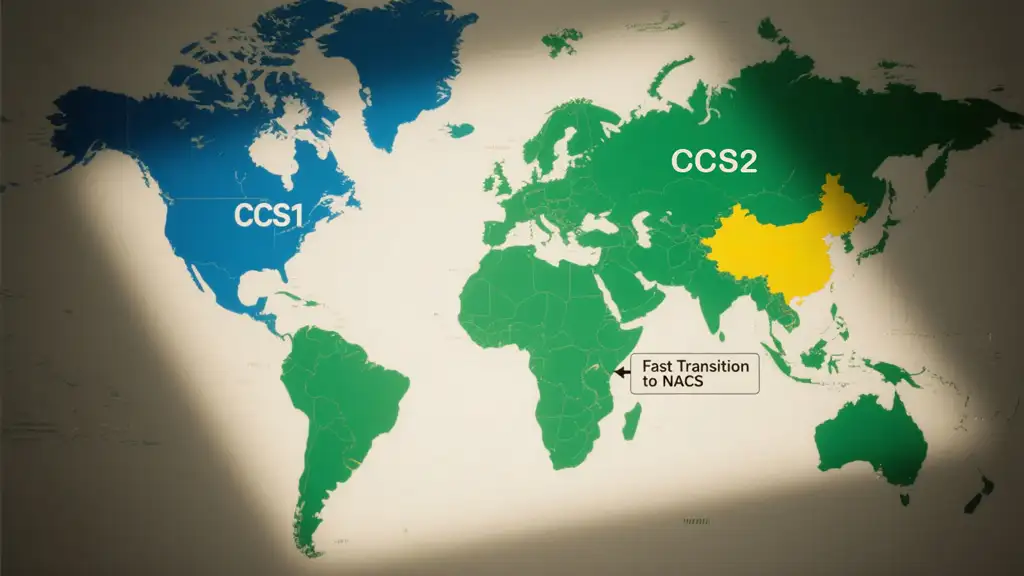
CCS1 (Combo 1): North American standard (USA, Canada, South Korea) built upon the J1772 AC connector, with two large DC pins beneath.
CCS2 (Combo 2): Global standard including Europe, Australia, India and most of Asia; uses the Type-2 (Mennekes) AC connector base plus DC pins.
Key takeaway: A CCS1 plug will not physically fit into a CCS2 port, and vice versa — without an adapter.
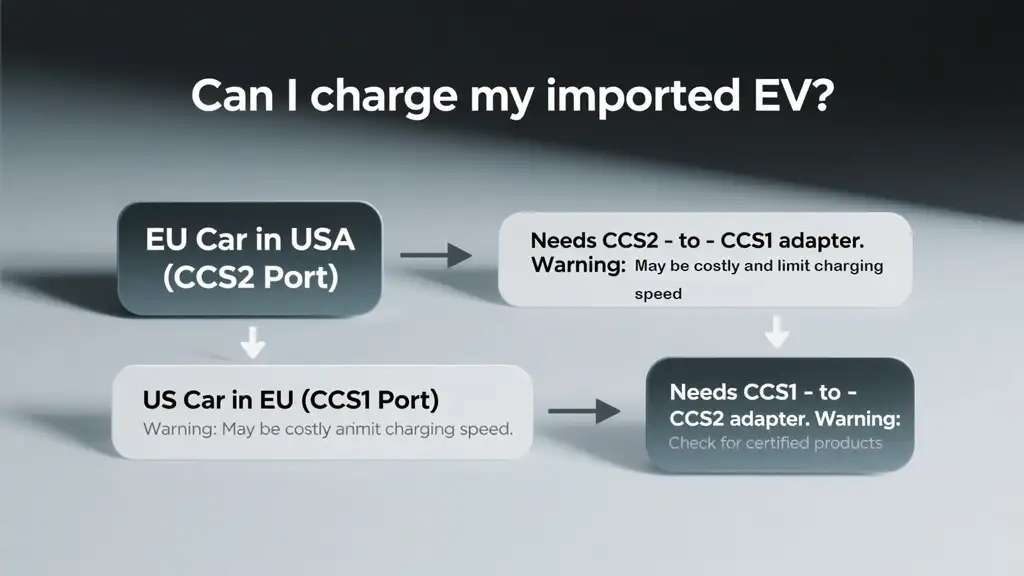
The most important thing to remember is that a CCS1 plug will not fit into a CCS2 vehicle port, and vice versa. They are not physically compatible without an adapter.
To understand the ccs1 vs ccs2 debate, you first need to know what CCS is. The Combined Charging System (CCS) was established by the CharIN association to unify AC and DC charging under one interface. It follows international standards such as IEC 62196-3 for connector design and ISO 15118 for digital communication between the EV and the charger, ensuring interoperability across manufacturers.
Every EV can charge using two current types:
AC Charging: The slower method (Level 1/Level 2) common at homes or workplaces.
DC Fast Charging: Highway-style rapid charging (Level 3) where power bypasses the car’s onboard charger and feeds directly into the battery.
Before CCS, some vehicles had separate ports for AC vs DC. CCS simplified that by combining them.
Before CCS, cars often needed two separate ports—one for AC and one for DC. The genius of CCS was combining both into one neat package. This made things simpler for automakers and drivers.
CCS communication is based on Power Line Communication (PLC) as defined in ISO 15118 and DIN 70121, which manages handshake, charging control, and safety verification.
The OCPP protocol, on the other hand, operates on the network level — it connects the charging station to cloud-based management systems, not directly to the vehicle.
the ocpp protocol (Open Charge Point Protocol) on the back end, which allows the charging station to talk to the network management system.
This communication is vital. It tells the car and charger:
How much power the battery can safely accept.
When the battery is full so it can stop charging.
Handles billing automatically in a system called “Plug & Charge.”
This smart communication is the foundation for all modern charging features, including Vehicle-to-Grid (V2G) technology.
While both are part of the same “CCS family,” their different designs and regional adoption create a major divide. Let’s break down the key differences between the ccs1 vs ccs2 plug.
As we saw earlier, the plugs look different. The CCS1 standard was built upon the existing North American j1772 charging plug, which was already widely used for Level 2 AC charging. To create a DC fast charging standard, designers simply added two large DC pins underneath the J1772 port.
In Europe, they had a chance to start fresh. They designed the Type 2 (Mennekes) connector from the ground up to handle both AC and DC in a more integrated and elegant way. This is why the CCS2 plug often looks cleaner and less clunky.
| Feature | CCS Combo 1 (CCS1) | CCS Combo 2 (CCS2) |
|---|---|---|
| Primary Region | North America (USA, Canada, S. Korea) | Europe, Australia, South America, Africa, parts of Asia |
| Based On | Type 1 (J1772) AC Connector | Type 2 (Mennekes) AC Connector |
| Physical Look | Separate round AC section on top | Integrated single-unit design |
| AC Power Capability | Single-phase AC power | Single-phase & Three-phase AC power |
| Primary Automakers (Legacy) | Ford, GM, Rivian, Hyundai (NA) | BMW, VW, Mercedes-Benz, Audi, Polestar |
| DC Power Rating | Up to ~350 kW | Up to ~350 kW (potentially higher) |
The single biggest ccs1 vs ccs2 difference is geography. If you buy a non-Tesla EV in the United States, it will almost certainly have a CCS1 port. If you buy one in Germany, it will have a CCS2 port. This regional split is a legacy of how the different continents developed their early AC charging infrastructure.
For DC fast charging, both CCS1 and CCS2 are capable of delivering very high power levels — up to 350 kW or more in advanced stations according to the IEC 62196 standard and CharIN guidelines. On pure charging speed, neither standard has an inherent advantage in DC performance.
Where they truly differ is in AC charging capability. Because many European installations use three-phase power, CCS2 supports higher Level 2 charging speeds compared to CCS1’s typical single-phase setup in North America. In practice, European Level 2 AC can reach ~22 kW with three-phase supply, whereas many North-American single-phase CCS1 vehicles top out around ~11 kW.
This means that for home or workplace charging, CCS2 may offer faster and more flexible performance in regions with three-phase infrastructure, while CCS1 remains limited by grid design rather than connector technology.
Historically, the charging standard race in North America involved CCS1, CCS2 (imported vehicles), and NACS (North American Charging Standard) — originally Tesla’s proprietary plug. Starting around 2023, major automakers announced a migration to NACS for future vehicles (Wikipedia: NACS).
According to authoritative sources, NACS (standardised as SAE J3400) uses the same communication protocols as CCS (ISO 15118 / DIN 70121) but with a more compact, ergonomic design (CharIN position on NACS).
Why is this happening? Because charging network size, reliability and ecosystem quality matter. Automakers recognized that joining Tesla’s Supercharger network offered better user experience and coverage than remaining with legacy CCS1 ports. For buyers in North America from model-year 2025 onward, NACS-native vehicles will likely have the widest fast-charging access across the continent.
For charge point operators (CPOs) and infrastructure investors managing CCS1 networks, the shift toward NACS does not signal immediate obsolescence. The CCS1 ecosystem remains substantial — tens of thousands of chargers are active, and federal programs such as the NEVI funding continue to support CCS infrastructure in the medium term.
However, strategic planning for cross-standard compatibility is now critical. Key implications include:
Adapter deployment strategy: Evaluate certified NACS–to–CCS1 DC adapters for selective site retrofits. Prioritize UL/CE and SAE J3400–compliant models to ensure full load capacity and interoperability.
Infrastructure upgrades: Future-proof new installations by integrating modular connector systems that support both NACS and CCS2 heads on a single pedestal.
Back-end software adaptation: Align your network’s OCPP 2.0.1 and ISO 15118 implementations to handle multi-standard authentication (“Plug & Charge”).
Risk and ROI management: Monitor policy alignment from DOE, SAE, and CharIN to balance CAPEX protection with customer accessibility during the transition period.
The most successful operators in 2025–2030 will be those who treat this shift not as a threat but as an opportunity to consolidate customer bases across connector types and become region-ready for multi-standard charging.
👉 Consult our engineering team for a scalable NACS migration roadmap → contact us
Planning network expansion or standard upgrades?
As global connector ecosystems evolve, charge point operators (CPOs), OEMs, and infrastructure investors need a clear strategy to maintain interoperability and ROI. The CCS1–to–NACS transition in North America, and the continued dominance of CCS2 in Europe and Asia, require region-specific planning.
North America: For new stations, prioritize hardware that supports NACS-native or dual CCS1/NACS configurations. Select chargers that comply with SAE J3400 and are compatible with OCPP 2.0.1 and ISO 15118 Plug & Charge. This ensures long-term flexibility and access to OEM-backed networks.
Europe & APAC: Continue standardizing on CCS2 infrastructure, as it remains the universal public DC fast-charging format. Focus investment on stations supporting three-phase AC (up to 22 kW) and 350 kW+ DC capabilities.
Emerging markets: Evaluate modular systems capable of supporting CCS2 and NACS simultaneously to attract global vehicle fleets.
Adapter integration: Use only certified NACS–to–CCS1 modules rated for full DC output. Integrate them into pedestal or cable-swapping systems for flexibility without compromising safety.
Grid and capacity planning: Anticipate increased demand from high-power NACS vehicles; plan for upgraded transformers, cooling, and load management software.
Investment protection: Align procurement with CharIN, SAE, and NEVI guidelines to ensure interoperability and access to funding incentives.
In short, network operators who embrace multi-standard compatibility will maximize uptime, user coverage, and capital efficiency as the market converges toward shared communication protocols rather than fixed connector shapes.
👉 Consult our engineering team for modular NACS–CCS2 deployment solutions → /contact
Globally, the evolution of EV connector standards is entering a phase of structural convergence. While CCS2 continues to dominate across Europe and most international markets due to its maturity and three-phase AC integration, North America’s transition to NACS demonstrates how user-experience-driven ecosystems can influence standard adoption.
Technically, the convergence will not begin with the plug shape but with software protocols and digital authentication. Core layers such as ISO 15118, DIN 70121, and the upcoming OCPP 2.0.1 implementations are already establishing a shared communication language between CCS and NACS platforms (CharIN position on NACS standardization).
Over the next few years, we expect:
Unified communication and billing standards, enabling seamless Plug & Charge across networks.
Hybrid infrastructure models, where a single site supports multiple connector formats under one management system.
Policy-driven funding alignment, particularly through NEVI (U.S.), AFIR (EU), and similar regional programs that encourage multi-standard accessibility.
For charge point operators, OEMs, and investors, the priority is to design networks that are protocol-ready, connector-agnostic, and region-compliant — ensuring operational longevity regardless of hardware shifts.
Q1: Can I charge a CCS1 car at a CCS2 charger?
No — the physical plugs differ and are not compatible. An adapter may exist but is rare and has limitations.
Q2: Does NACS charge faster than CCS?
Not inherently. Charging speed depends on charger capacity, vehicle acceptance rate, and power source. The plug design doesn’t alone dictate speed.
Q3: Should I worry about investing in home charging equipment now?
If your home is in Europe or region with CCS2 dominance, choose a charger supporting Type 2/CCS2. In North America, if you’re buying a 2025+ EV, consider a charger compatible with NACS (or adapter-ready) to future-proof.
Authoritative Sources
Combined Charging System (CCS) Charter: CharIN e.V. (2025). About Us: https://www.charin.global/about-us/
U.S. Joint Office of Energy and Transportation on EV Charging: Joint Office of Energy and Transportation. (2025). Standards and Reliability: https://driveelectric.gov/standards-reliability
Ford Announcement on NACS Adoption: Ford Motor Company. (2023). Ford EV Customers to Gain Access to 12,000 Tesla Superchargers, Expanding BlueOval Charge Network:https://media.ford.com/content/fordmedia/fna/us/en/news/2023/05/25/ford-ev-customers-to-gain-access-to-12-000-tesla-superchargers.html
CCS Specification — CharIN: https://www.charin.global/technology/ccs-specification
IEC 62196 Standard — Wikipedia: https://en.wikipedia.org/wiki/IEC_62196
ISO 15118 Standard — ISO: https://www.iso.org/standard/55365.html
NACS / SAE J3400 — DriveElectric: https://driveelectric.gov/charging-connector
CharIN statement on NACS standardisation: https://www.charin.global/news/charin-stands-behind-ccs-and-mcs-but-also-supports-the-standardization-of-tesla-nacs
ISO 15118 & OCPP interoperability article — AMP Control: https://www.ampcontrol.io/post/iso-15118-and-ocpp-2-0-the-dream-team-for-smart-charging
From initial consultation to seamless installation, our expert team delivers custom EV charging solutions tailored to your business needs.
We will send detailed technical info and quotation to you!