If you’ve just bought an electric vehicle or are considering one, you’ve likely come across some confusing terms. One of the most common questions is: Is a Level 2 Charger the Same as a 240 Volt Charger? It’s a great question. The short answer is yes. But there’s a crucial conceptual difference between them. Understanding this distinction is essential when choosing and installing a home EV charger. This article will provide a deep dive into both concepts.
Many car owners realize that relying on the Level 1 charger that came with their car (which uses a standard household outlet) isn’t fast enough. This is directly related to the charging level, and they begin looking for a faster charging method: Level 2 charging. However, when they consult an electrician, they might hear the phrase, “You need to install a 240-volt outlet.” These two terms seem to point to the same thing but aren’t exactly alike. We will use simple language to explain what a Level 2 charger is, what 240 volts means, and provide practical advice.
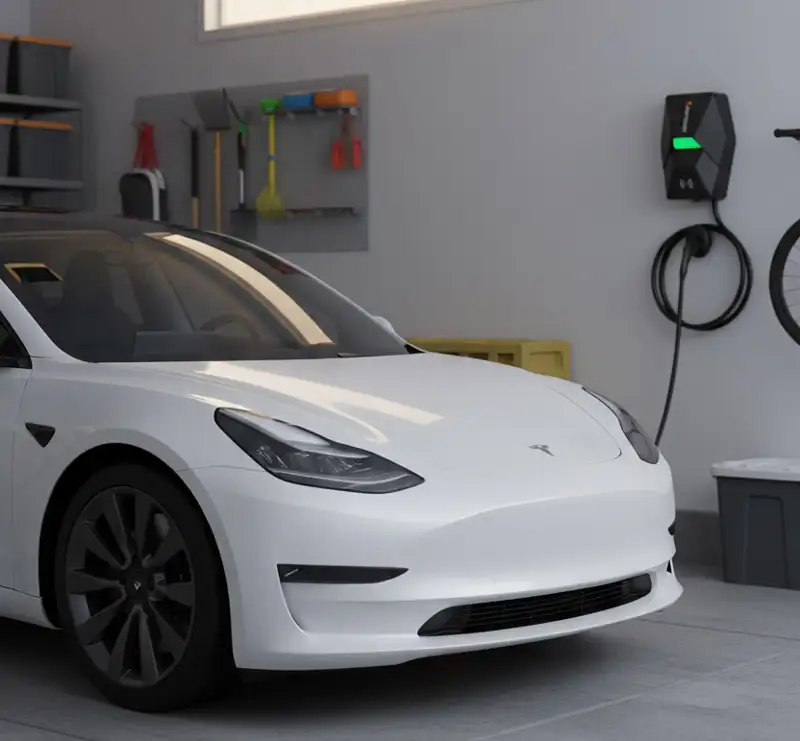
A Level 2 charger uses 240 volts. This is the most direct answer. You can think of them as two different ways of describing the same thing. Level 2 is a charging standard or classification as defined by the SAE J1772 standard. In contrast, 240 volts is an electrical specification, a specific voltage level. It refers to the power voltage that the charger uses. The two terms are often used interchangeably because in North America, to achieve Level 2 charging, you must use a 240-volt power source. Without 240 volts, Level 2 charging is not possible.
Imagine you’re building a house. You could say you want a “three-bedroom, two-bathroom” house. This is the standard. It defines the function and layout. To achieve this, you need to use “steel-reinforced concrete” and “red bricks” as your materials. Here, the “three-bedroom, two-bathroom” is Level 2, while the “steel-reinforced concrete” and “red bricks” are the 240 volts. They are two different layers of the same goal. One describes the outcome, and the other describes the tool.
Here’s another example. You could say you bought a “sports car.” A sports car is a type or standard. For the car to be fast, it might use a “3.0-liter engine.” The “3.0-liter” is the specification. Similarly, a Level 2 charger is the type, and 240 volts is the specification. They are complementary, but technically, they refer to different things.
A Level 2 charger is an Electric Vehicle Supply Equipment (EVSE). It delivers high-voltage alternating current (AC) to the electric vehicle’s on-board charger through a special connector (usually the J1772 standard). The power of Level 2 charging typically ranges from 3.3 kilowatts (kW) to 19.2 kW. This power range is significantly higher than Level 1 charging.
Understanding the speed difference between charging levels is crucial. The following table clearly shows the distinctions.
Understanding the speed difference between charging levels is crucial. The following table clearly shows the distinctions.
Charging Level | Charging Voltage (V) | Charging Power (kW) | Charging Speed (Miles of Range Added Per Hour) | Best Use Case |
|---|---|---|---|---|
Level 1 | 120V | 1.4 – 2.4 kW | 3 – 5 miles | Emergency or overnight top-up charging |
Level 2 | 240V | 3.3 – 19.2 kW | 20 – 60 miles | Home, Office, Public Parking Lots |
DC Fast Charging | 400 – 900V+ | 50 – 350+ kW | 180 – 1000+ miles | Long-distance travel, quick top-ups |
Note on Public Charging: In commercial or public spaces, Level 2 chargers often draw power from a three-phase electrical system at 208 volts instead of 240 volts. This is a crucial distinction for electricians but for the average user, it doesn’t change the “Level 2” designation. A 208V Level 2 charger will simply have a slightly lower power output (e.g., a 40A charger on a 208V circuit provides 8.3kW instead of 9.6kW on a 240V circuit).
Level 2 charging offers a perfect balance. It’s much faster than Level 1 but doesn’t require the complex grid infrastructure of DC fast charging. At home, it can fully charge your car while you sleep. At the office, it can replenish your car’s battery while you work. For most EV owners, a Level 2 charger is sufficient for their daily needs. It is both efficient and convenient.
There are many excellent Level 2 charger brands on the market. They all use 240 volts. Mainstream brands include but are not limited to:
JuiceBox by Enel X
ChargePoint Home Flex
Wallbox Pulsar Plus
Tesla Wall Connector
Grizzl-E Classic
Linkpowercharging
These brands usually offer different amperages to suit various charging needs and home electrical conditions.
In North America, we generally have two types of voltage. One is the standard 120-volt, used for everyday small appliances like lamps, TVs, and computers. The other is 240 volts, designed for appliances that require a lot of power. These appliances include clothes dryers, electric stoves, central air conditioners, and electric water heaters. A Level 2 charger needs to use 240 volts to deliver higher power and, thus, charge your EV faster.
From a physics perspective, power is equal to voltage multiplied by current. In other words, Power = Voltage × Current. If your current (amperage) remains the same, but you double the voltage, the power will also double. This is why a 240-volt charger can be much faster than a 120-volt charger. It delivers power to your car at double the voltage.
Higher voltage allows a device to transfer more energy in a shorter amount of time. Imagine using a thin hose (120V) versus a thick hose (240V) to fill a bucket (the EV battery). The thick hose will fill the bucket much faster. This is why 240 volts allows a Level 2 charger to have a much faster charging speed. Many people wonder if faster charging harms the battery. According to a study by the U.S. Department of Energy, it has been scientifically proven that routine use of DC fast charging does not have a significant impact on battery degradation under normal conditions. It’s important to note that extreme temperatures and improper use can affect battery health regardless of charging speed. To learn more, you can read The Truth About Slow vs. Fast Charging and Your Battery’s Lifespan.
Identifying a 240V outlet is simple. They look completely different from standard 120V outlets.
NEMA 14-50: This is the most common 240V outlet. It typically has four holes: two slanted slots, one straight slot, and a round ground pin.
NEMA 6-50: This outlet is often used for welding machines and has two slanted slots and one round ground pin. If you have a clothes dryer or an electric stove, you likely already have a 240V outlet. However, never plug an EV charger into it without consulting a professional, as the amperage may not be compatible.
To learn more about their home applications, check out NEMA 14-50 vs NEMA 6-50. If you want a safer way to charge your EV, NEMA 10-30 vs 14-50 will give you more references.
A hardwired charger is one that doesn’t have a plug and is connected directly to your home’s electrical panel. This method is common for home charging because of its unique advantages.
Advantages:
Maximum Charging Power: Since there are no plug limitations, hardwired chargers can often provide higher amperage, leading to faster charging speeds, such as 48, 80, or 96 amps.
Clean Look: Without a bulky plug, the wall-mounted installation is cleaner and saves space.
Higher Safety: The direct connection avoids the safety risks associated with a loose plug or poor contact.
Disadvantages:
Less Flexible: Once installed, the location is fixed and cannot be easily moved.
Requires Professional Installation: Because it connects directly to the electrical system, it must be installed by a licensed electrician.

In daily conversation, people often use a more intuitive word to replace a complex concept for simplicity. For the average consumer, the term 240 volts more directly describes the electrical requirements of the charger. It helps them understand the electrical needs better than “Level 2 charger.” As a result, it has become common practice to use them interchangeably.
Many charger manufacturers and installation companies also use “240-volt charger” or “240V charging station” in their marketing to attract customers. This phrase is easier for potential customers to understand and helps them realize that this is a service that requires professional installation.
The official name for a Level 2 charger is Electric Vehicle Supply Equipment (EVSE). The EVSE’s main function is to safely deliver power to the car and communicate with it. But this term is too technical, and most people prefer to use the word “charger.” This language habit also contributes to the interchangeable use of 240 volts and Level 2.
When you’re talking about home charging, you can often use these terms interchangeably.
If you want to tell a friend you’ve installed a faster charging setup, you can say, “I installed a Level 2 charger.”
If you’re talking to an electrician, you would say, “I need a 240-volt circuit installed for my EVSE.”
Amperage is the magnitude of the electrical current. It, along with voltage, determines the charger’s power. Power (kW) is the key metric for measuring charging speed. The formula is as follows:
Power (kW) = Voltage (V) × Current (A) ÷ 1000
For example, a charger using 240V and 40 amps has a power of: 240V × 40A ÷ 1000 = 9.6kW.
Most Level 2 charger models offer different amperages. The following table shows the charging speed differences for various amperages.
Amperage (A) | Rated Power (kW) | Typical Charging Speed (Miles of Range Added Per Hour) | Applicable Models |
|---|---|---|---|
32A | 7.7 kW | 25 – 30 miles | Most EVs, suitable for daily charging |
40A | 9.6 kW | 30 – 35 miles | Vehicles with larger batteries |
48A | 11.5 kW | 40 – 45 miles | Vehicles that support higher charging power, like Tesla Model 3/Y |
When choosing the amperage, you need to consider three factors:
Your vehicle’s on-board charger limit: Your EV has a built-in on-board charger that determines the maximum AC power it can accept. If your car can only accept a maximum of 11.5kW, there’s no point in installing a higher-power charger.
Your home’s electrical capacity: Your home’s electrical panel must have enough capacity to support your charger. Do You Need a Dedicated Circuit for an EV Charger?
Future-proofing: If you plan to replace your EV with one that has a larger battery in the future, you might consider installing a slightly higher-power charger.
The National Electrical Code (NEC) specifies that a charger’s operating current should not exceed 80% of the circuit breaker’s rating. This is outlined in NEC Article 625.
If you install a 48A charger, you need a 60-amp circuit breaker.
If you install a 40A charger, you need a 50-amp circuit breaker.
If you install a 32A charger, you need a 40-amp circuit breaker.
This is a critical safety rule that must be followed strictly.
Before installing a Level 2 charger, you need to assess whether your home’s electrical panel can support the new 240V circuit.
Does your electrical panel have enough space?
Is the total capacity of the panel sufficient? If your electrical panel is too old or lacks capacity, you might need an upgrade, which will add to the installation cost.
Installation costs vary by region and specific circumstances.
If your electrical panel is close to the garage and has spare capacity, the installation cost may be lower, typically between $500 and $1,000.
If a long wire needs to be run or the electrical panel needs an upgrade, the cost could increase to over $2,000. Some states or regions may offer EV charger installation rebates.
If you have your own garage, you can refer to where to install the charger in the garage.
If you’re a tenant, this article on a guide to installing chargers in a rented home is more suitable for you.
It is strongly recommended that you hire a professional, licensed electrician for the installation. This is not just about convenience but also about safety and compliance with building codes. The National Electrical Code (NEC), specifically Article 625, requires all EVSE installations to be performed by a qualified individual.
Safety Risks: 240 volts is extremely dangerous. Incorrect installation can lead to fire or electric shock.
Warranty Issues: If you perform the installation yourself and something goes wrong, the charger manufacturer’s warranty may become void.
Regulatory Compliance: Many areas require all electrical installations to be done by a professional and to pass a government inspection.
The electrician will select the appropriate wire gauge and circuit breaker based on your charger’s power and the wire’s length. This is the foundation of charging safety. The wrong wire gauge can overheat and cause a fire. For a more detailed installation guide, refer to home charger installation.
Public parking lots, shopping malls, and office buildings tend to install Level 2 chargers.
Cost-Effectiveness: Compared to Level 3 EV Charger, Level 2 chargers have a lower installation cost.
Less Grid Strain: Level 2 charging puts much less strain on the electrical grid than DC fast charging.
Longer Dwell Time: At these locations, car owners usually stay for a few hours, and Level 2’s charging speed is perfectly sufficient.
Using a public charger typically involves these steps:
Find a Charger: Use a charging network app (like ChargePoint, Electrify America) or your car’s built-in navigation to find a nearby charger.
Pay or Activate: Activate the charging session by scanning a QR code with an app, using an NFC card, or a physical card. To learn more about how to pay for EV charging can make your payment easier.
Connect the Vehicle: Insert the charging connector into your EV’s charging port.
Start Charging: Wait for the charger and vehicle to establish a connection and begin charging.
There are several ways public chargers can bill you:
By the hour: You are charged based on the duration of your charging session.
By kilowatt-hour (kWh): You are charged based on the amount of electricity you’ve added to your car.
Hybrid billing: A combination of time and electricity used.
Free: Some businesses offer free Level 2 charging as a perk for customers.
In North America, the main public Level 2 charging networks include:
ChargePoint: One of the largest charging networks, with chargers everywhere.
EVgo: Offers both Level 2 and DC fast charging services.
Electrify America: Primarily focuses on DC fast charging but also provides some Level 2 chargers.
Flo: Provides services in Canada and parts of the U.S.
Linkpowercharging: Provides both Level 2 and DC fast charging services in North America.

Most EVs can use a Level 2 charger. With the exception of Tesla, all other EVs use the J1772 as their standard Level 2 charging connector. Tesla vehicles can use a J1772 adapter to connect to Level 2 chargers. As Tesla opens its NACS standard to the public, future Level 2 chargers may support both J1772 and NACS.
Yes, a Tesla Wall Connector is a Level 2 charger. It uses 240V and provides comparable power to a typical Level 2 charger.
When buying, consider the following factors:
Amperage: Choose the right amperage based on your vehicle and home’s electrical capacity.
Cable Length: Ensure the cable is long enough to reach your car’s charging port from the charger. Linkpowercharging can provide 5M or 7M cable lengths.
Smart Features: Some smart chargers can be controlled via an app, allowing you to set charging schedules and view charging history.
Indoor/Outdoor Certification: Make sure the model you choose is rated for indoor or outdoor installation.
If your charging speed is slower than expected, there could be several reasons:
Vehicle’s on-board charger limit: Your car might not be able to accept all the power the charger provides.
Wire loss: The longer the wire, the more energy is lost.
Vehicle’s battery status: When the battery is close to being full, the charging speed will slow down to protect battery life.
Temperature: Extreme temperatures can also affect charging efficiency.
Both voltages are used for Level 2 charging, but in different settings. Residential Level 2 chargers almost always use 240V, which is a single-phase voltage typical for North American homes. Commercial or public Level 2 chargers often use 208V, which is a lower voltage derived from a three-phase power supply common in commercial buildings. While the charging speed at 208V is slightly slower than at 240V, both are classified as Level 2 charging.
Through this in-depth discussion, we hope you now have a clear understanding of Level 2 chargers and 240 volts. In short, while the two terms are often used interchangeably, they represent two different layers of EV charging—one is a standard, and the other is a physical specification. Understanding this will help you communicate more effectively with electricians and salespeople and make more confident decisions about the right charging solution for your EV.
Ultimately, whether you call it a “Level 2 charger” or a “240-volt charger,” their purpose is the same: to provide you with a faster, more efficient home charging experience. When you make your decision, always consult with a professional to ensure your charging setup is safe and compliant with all electrical codes.
Authoritative Sources
From initial consultation to seamless installation, our expert team delivers custom EV charging solutions tailored to your business needs.
We will send detailed technical info and quotation to you!