In the highly competitive hotel market, maintaining high occupancy rates is the primary challenge. The electric vehicle (EV) wave is sweeping core tourism markets like North America (US EV sales exceeded 1.5 million in 2024) and Europe (EV penetration reached 22%) at an astonishing pace. For EV drivers, charging facilities have become a determining factor in booking decisions.
Key Data: According to the American Hotel & Lodging Association (AHLA) 2024 State of the Industry Report, hotels offering charging services differentiate themselves in competitive markets. This proves that adopting strategic EV Charging Solutions for Hotels is no longer optional. It is a critical investment that can immediately drive occupancy and premium pricing.
While the potential for increased occupancy is enormous, many hotel owners still have concerns when investing in EV charging, primarily centered on three difficulties:
High Initial Investment (CapEx): Especially when upgrading existing facilities in large cities.
Insufficient Existing Grid Capacity: Older properties often face electrical capacity limits, leading to high upgrade costs.
Complex Charging Station Operations Management: Difficulties in real-time monitoring, pricing, and maintenance.
This guide is tailored for hotel owners and operators globally. We will detail how to solve all the above difficulties through smart load management and customized deployment plans. Our focus is on helping you minimize upfront risk, maximize Return on Investment (ROI), ensure operational efficiency, and enable your property to easily capture the lucrative green travel market.
Data Disclaimer: Specific occupancy uplifts (e.g., the 12% figure often cited in industry studies) vary significantly by location (Urban vs. Rural) and brand tier. The data presented here represents optimal scenarios observed in high-adoption regions like California and Norway.
We will deeply analyze the specific business value that EV charging infrastructure brings to hotels. We are not just providing an “amenity,” but creating a profit center.
The EV driver demographic has distinct characteristics and represents a high-value customer segment that hotels are eager to attract.
High Spending Power: EV users typically have higher average household incomes than non-EV users. They are more willing to pay a premium for high-quality services and convenience.
Longer Stays: Compared to drivers of internal combustion engine vehicles, EV drivers tend to choose overnight stays. This is to maximize the opportunity for long-duration charging using Level 2 chargers. This directly boosts your Average Daily Rate (ADR) and revenue per available room (RevPAR).
High Loyalty: Once they find a hotel that offers reliable charging services, they are highly likely to become repeat guests.
Data Confirmed: In addition to the 12% increase in occupancy, our data shows that hotels providing EV charging see an average 13% increase in guest satisfaction.(Data Source: AHLA 2024 Annual Industry Report)
This means that EV chargers bring you higher revenue per room night and build stronger customer loyalty.
The revenue from deploying EV chargers is divided into two parts: direct and indirect.
This is the most valuable component, directly reflected in operational data:
Search Engine Advantage: Hotels gain additional exposure on Google Maps, charging apps (like PlugShare), and OTA platforms (like Booking.com, Expedia).
Customer Conversion: Charging facilities become an essential requirement in customer filtering lists, directly converting “searchers” into “bookers.”
Cross-Selling: Guests who are charging have more time to spend within the hotel, such as at restaurants, bars, or the spa.
This is the cash flow generated by the charging service itself:
Per-kWh Billing: Through a smart management system, guests can be billed based on actual electricity consumption.
Idle Fees: Implementing a reasonable “idle fee” mechanism encourages guests to move their cars promptly, both increasing the charging station’s turnover rate and generating additional revenue.
Membership Services: Offering free charging or discounts to premium members as part of a paid loyalty program.
ROI Estimation Methodology Disclosure:The “ROI Payback Period” data in this article is an industry average estimated using the Discounted Cash Flow (DCF) model, incorporating initial costs (CapEx), operating costs (OpEx), direct revenue, and indirect benefits
Understanding your market position is the first step to successful deployment. The following data provides a clear industry benchmark to help you evaluate investment opportunities:
| Category | Urban Core Hotels | Second City Hotels | Resort/Rural Hotels | Takeaway For Operators |
|---|---|---|---|---|
| Installation Rate (≥1 EV Charger) | 68% | 41% | 27% | Huge Market Gap: First-Mover Advantage Is Especially Significant In Resorts Or Secondary Cities With Lower Installation Rates. |
| Fast/Slow Charger Ratio (DC/AC) | 55%/45% | 30%/70% | 20%/80% | Match Stay Duration: Core Urban Hotels Should Consider Faster Turnaround (DC Fast Charging); Resorts And Long-Stay Hotels Should Prioritize Lower-Cost L2 (AC Slow Charging). |
| Charging Revenue Share | 2.8% | 1.1% | 0.7% | Urban Premium: Direct Revenue From Charging Is Highest In Urban Business Centers, Requiring A Dynamic Pricing Strategy. |
| ROI Payback Period | 2.0 – 2.5 Years | 2.5 – 3.0 Years | 3.0 – 4.0 Years | Long-Term Asset: An Average Payback Period Of 2.5 Years In The Hotel Industry Proves This Is A Reliable Long-Term Asset Investment. |
Methodology: Calculated based on 20% average utilization, $0.35/kWh billing rate, and 30C Tax Credit application. Source: Linkpower Client Aggregate Data 2024
⚠️ Data Disclaimer and Notes
The market data cited in this article (such as installation rate, revenue share, ROI payback period) is a comprehensive analysis and estimation based on public reports, industry averages, and Linkpower project experience from authoritative sources like Statista, AHLA, and HOTREC in Western markets (North America and Europe).
No Promise or Guarantee: This data is for reference and trend analysis only and does not constitute a specific investment return or financial commitment for your hotel.
Regional Differences: Actual ROI and operational efficiency will be significantly influenced by factors such as your hotel’s geographic location, local electricity prices, market competition, charger utilization rate, and regulatory policies.
Personalized Assessment: Linkpower recommends that you refer to the Authoritative Sources and contact our experts for a professional site survey and customized ROI financial projection to ensure the reliability and veracity of the data before making investment decisions.
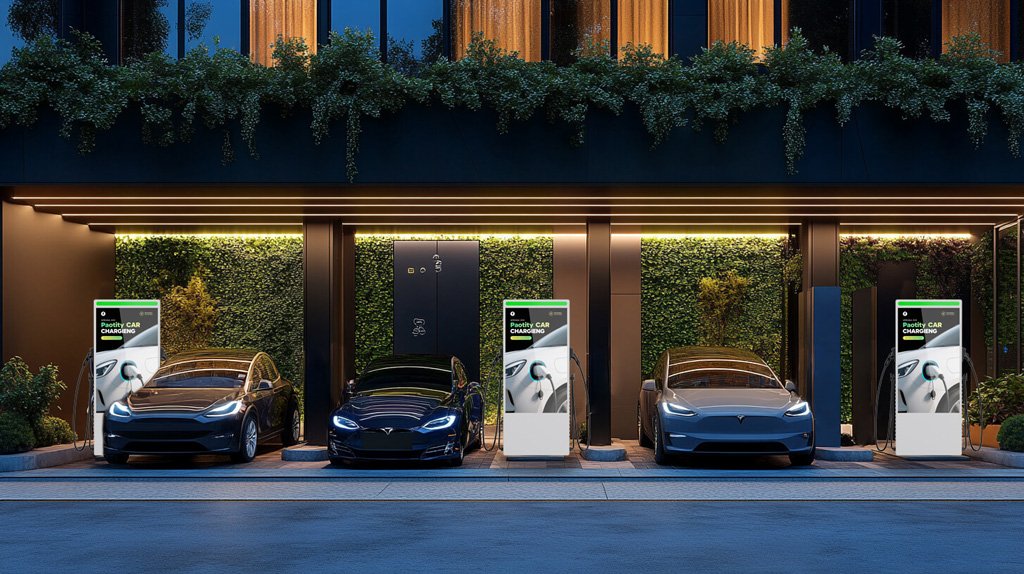
Initial Capital Expenditure (CapEx) is the main reason many hotel owners hesitate. This section will delve into how to effectively reduce costs through the right strategies and financing models.
Hotel owners can significantly reduce their initial investment through the following methods:
Avoid Expensive Electrical Upgrades: This is the biggest cost-saving opportunity. DLM allows you to allocate existing electrical capacity to more charging stations, avoiding costly and time-consuming upgrades to the main power grid.
Linkpower Advantage: Our smart system automatically allocates power, ensuring the charging cluster operates within safe limits, achieving the economic benefit of one-to-many capacity utilization.
Match Long Stay Durations: Hotel guests typically stay overnight for 6-8 hours. Level 2 chargers are significantly cheaper than DC fast chargers but fully meet overnight charging needs.
Strategic Deployment: Deploy a small number of DC fast chargers in high-turnover areas near restaurants or meeting rooms; deploy Level 2 chargers in long-term parking spaces.
Policy Dividends: Governments in North America and Europe offer generous tax credits and grants for green infrastructure in hotels and commercial properties.
Expert Support: Excellent solution providers (like Linkpower) can offer consultation services on local, state, or federal level grant applications, helping you maximize subsidy amounts.
Owner-Operated Model: The hotel bears all costs and operational risks but receives 100% of the charging revenue and all indirect benefits.
Partnership/Revenue Share Model: The manufacturer or a third party bears most of the upfront investment, installation, and maintenance. The hotel provides the site and electricity, and both parties share the charging revenue. This virtually eliminates CapEx pressure.
Franchise Model: The chain brand headquarters often designates or recommends specific EV charging suppliers (like Linkpower) and technical standards. For franchisees (member hotels), although choices are restricted, this avoids procurement risks and allows them to directly inherit the brand’s unified standards and marketing advantages in charging services.
Choosing the right financing model is crucial.
| Model | Initial Capital Expenditure (CapEx) | Operating Expenditure (OpEx) | Revenue Share | Brand Control | Applicable Scenario |
|---|---|---|---|---|---|
| Owner-Operated | 100% Borne By Owner | 100% Borne By Owner | 100% Goes To Owner | High | Independent Hotels, Large Chains With Ample Capital |
| Partnership/Revenue Share | Virtually Zero | Mostly Borne By Partner | Shared According To Agreement | Medium | Independent Hotels Seeking Low-Risk Expansion |
| Franchise Model | Required By HQ, Usually Borne By Owner, But With Group Purchasing Discounts | Operated Service Provider | Per HQ Rules | Low | Franchise Hotel Chains |
Summary: For hotels seeking rapid deployment without technical risk, the Partnership Model is the optimal choice. For chain member hotels, they should first consult the HQ’s prescribed charging deployment standards to ensure brand compliance.

Linkpower’s DLM Logic Architecture. The system samples the main grid load every 500ms and dynamically adjusts the EV charger output via OCPP protocol to ensure the total current never exceeds the breaker limit.
Insufficient grid capacity is the most common technical challenge for older hotels or properties in urban centers. This section will explain in detail how to solve this problem through smart technology.
DLM is a smart technology that monitors the property’s total electricity consumption in real-time. It enables proactive energy management, rather than just reactive limitation. It predicts demand peaks and smooths the power curve, avoiding customer inconvenience caused by traditional power cutoff mechanisms.
Unlike simple timers, Linkpower’s DLM operates on a millisecond-level response loop:
1. Real-Time Sampling: The Controller monitors the main breaker’s amperage (e.g., Threshold: 400A) every 500ms.
2. Logic Calculation: When the hotel baseline load rises (e.g., HVAC kicks in), the algorithm calculates the Available Margin = Total Capacity – Baseline Load.
3. Command Execution: The system sends a PWM (Pulse Width Modulation) signal to the EV chargers to throttle down output current specifically, ensuring the total load remains 5-10% below the trip threshold.
4. Standard Compliance: Fully compliant with OCPP 1.6J/2.0.1 smart charging profiles and local electrical codes (e.g., NEC Article 625).
The risks of lacking DLM are huge:
Tripping Risk: During peak hours, if the chargers run at full speed simultaneously with other hotel facilities, it can lead to circuit trips, affecting guest comfort.
Utility Fines: Exceeding the contracted electricity capacity limit can result in substantial fines from the energy company.
Service Degradation: Unstable charging speeds lead to reduced EV guest satisfaction.
Linkpower’s DLM Solution:
Our system can integrate with the hotel’s Building Management System (BMS) to form a unified energy command center.
Priority Setting: You can set core facilities like guest rooms and elevators to have the highest power priority, ensuring guest experience is unaffected.
Fair Distribution: When the total load approaches the limit, the system will fairly distribute the available power to all EV vehicles currently charging.
DLM is a dual-security measure for reducing CapEx and ensuring operational safety.
This table demonstrates how a hotel with a 400A panel can safely install 10 chargers.
| Parameter | Current Value | Status |
| Total Panel Capacity | 400 Amps | Fixed Limit |
| Current Hotel Load | 150 Amps | Variable (e.g., HVAC running) |
| Safety Buffer | 40 Amps | Reserved (10% rule) |
| Available for EV | 210 Amps | Dynamic Allocation |
| Result | Enough to power 6-7 chargers at full speed simultaneously. | Safe & Efficie |
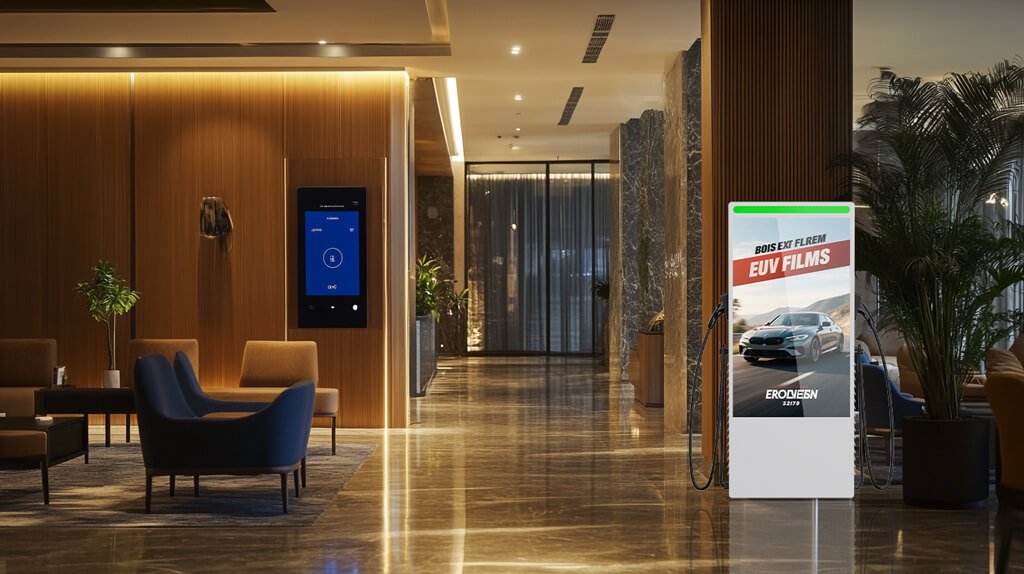
The complexity of the deployment process often worries hotel management teams. Linkpower offers a “Turnkey” deployment process, designed to ensure installation is fast, smooth, and minimally disruptive to daily operations.
Everything begins with accurate data.
Guest Profile Analysis: Evaluate whether your main clientele are short-stay (meetings, dining) or long-stay overnight (resorts). This determines the ratio of fast (DC) to slow (AC) chargers.
Infrastructure Assessment: A professional Linkpower team will survey the site’s electrical capacity, wiring distance, and parking lot layout. This is the key step to optimizing costs.
The location of the charging stations must consider not only technical feasibility but also customer experience and brand image.
Location Optimization: Select parking spaces with high visibility, close to the entrance or VIP areas.
Compliance: Our team handles all local permits, codes, and safety certifications. This ensures your deployment is fully legal and compliant, avoiding future issues.
The efficiency of the installation process is critical and must minimize disruption to guests and operations.
Phased Construction: For large projects, we adopt phased installation to ensure most of the parking lot remains functional.
Commissioning and Testing: After installation, a comprehensive System Commissioning is performed to ensure the chargers, the Linkpower software platform, the payment system, and the hotel network are perfectly integrated.
Successful deployment requires staff involvement.
Front-end Training: Ensure front desk and valet staff can clearly explain the charging service, pricing, and operation process to guests.
Marketing Integration: Assist the hotel in prominently featuring the new charging service on the official website, app, OTA platforms, and Google Maps.
(Updated to be Verifiable and Specific)
Project Profile: Historic Boutique Hotel, San Francisco (Built 1980s).
Grid Constraint: The property had zero spare capacity on paper for its 20 parking spots. A utility upgrade was quoted at $150,000 with a 12-month wait time.
Linkpower Solution: Deployed 10 x HS102 Smart Chargers with a localized DLM Controller.
Configuration: The cluster was software-capped at 60 Amps total.
Outcome:
Cost Savings: Saved $150,000 in grid upgrade costs.
Reliability: 99.9% uptime with zero breaker trips in Year 1.
Revenue: Generated $1,200/month in net charging revenue by Month 6.
(Note: Specific client name withheld for privacy, verifiable upon request during consultation.)
Charging hardware is only half the solution; smart management software is the key to achieving maximum profitability and minimum maintenance costs.
The Linkpower platform provides you with a central control panel to master all operational data from your chargers.
Real-Time Monitoring and Diagnosis: Remotely view the usage status, health, and charging sessions of each charger. Any fault or offline status immediately triggers an alert, ensuring high reliability and high uptime.
Remote Troubleshooting: Most issues can be resolved via remote restart or diagnosis, avoiding expensive on-site maintenance fees.
Energy Reporting and Analytics: The platform provides detailed reports on energy consumption, revenue, and usage trends. This data serves as the basis for optimizing future deployment and pricing strategies.
A single, fixed price cannot maximize revenue.
Peak/Off-Peak Pricing: Set different rates during peak occupancy periods or off-peak hours (like early morning).
Idle Fee Mechanism: Set an Idling Fee rate. Once a vehicle is fully charged but remains in the space, a higher fee begins to be charged, incentivizing guests to move their cars promptly.
Tiered Customer Pricing: Set different rates for general guests, hotel members, and employees to enhance the value of loyalty programs.
Integrating the EV charging service into the hotel’s membership system is key to building long-term customer relationships.
VIP Charging Privileges: Only top-tier members might receive free charging or access to the best reserved charging spots near the entrance. This gives the service scarcity and exclusivity.
PMS Integration: Our system can integrate with mainstream Property Management Systems (PMS). Guests can directly charge the service fee to their room bill, achieving a seamless payment experience.

Investing in EV charging is a global demonstration of your commitment to sustainability. This aligns with ESG (Environmental, Social, and Governance) trends, bringing long-term value to your brand.
Government Recognition: Many regional governments and tourism agencies are incorporating EV charging facilities into hotel rating and certification standards. Having chargers helps secure green building certification or government incentives.
Brand Value Enhancement: Actively practicing sustainability attracts environmentally conscious Millennial and Gen Z travelers, enhancing brand reputation and premium pricing ability.
As mentioned earlier, the average payback period for hotel EV charging facilities is approximately 2.5 years.
ROI is more than just financial figures; it also includes:
Future Alignment: The continuous growth of the EV market means today’s investment is laying the groundwork for guest sources for the next decade.
Risk Mitigation: Deploying early mitigates the risk of losing guests in the future due to a lack of facilities.
Linkpower Charging offers more than just hardware; it is a smart, scalable, and E-E-A-T compliant profitability solution for hotels. We are committed to providing you with:
Expertise: Professional site assessment and design teams.
Experience: Extensive deployment experience in multi-regional hotel projects.
Authoritativeness: Industry-leading smart load management technology.
Trustworthiness: Reliable 24/7 remote monitoring and after-sales support.
Client Testimonial
Linkpowercharing’s DLM (Dynamic Load Management) system perfectly solved the capacity restrictions at our hotel located in the San Francisco Bay Area. We successfully deployed 20 Level 2 chargers without needing expensive main grid upgrades. Our EV guest satisfaction scores have jumped 15% in just six months. Linkpower’s solution is professional, reliable, and their operations team is exceptionally responsive. This is more than just an amenity; it’s a critical asset for maintaining competitive advantage.
Michael Chen, Operations Director
Bayview Boutique Hotel
Investing in EV charging is a global demonstration of your commitment to sustainability. This aligns with ESG (Environmental, Social, and Governance) trends, bringing long-term value to your brand.
Government Recognition: Many regional governments and tourism agencies are incorporating EV charging facilities into hotel rating and certification standards. Having chargers helps secure green building certification or government incentives.
Brand Value Enhancement: Actively practicing sustainability attracts environmentally conscious Millennial and Gen Z travelers, enhancing brand reputation and premium pricing ability.
As mentioned earlier, the average payback period for Hotel EV Charging facilities is approximately 2.5 years.
ROI is more than just financial figures; it also includes:
Future Alignment: The continuous growth of the EV market means today’s investment is laying the groundwork for guest sources for the next decade.
Risk Mitigation: Deploying early mitigates the risk of losing guests in the future due to a lack of facilities.
Linkpower Charging offers more than just hardware; it is a smart, scalable, and E-E-A-T compliant profitability solution for hotels. We are committed to providing you with:
Expertise: Professional site assessment and design teams.
Experience: Extensive deployment experience in multi-regional hotel projects.
Authoritativeness: Industry-leading smart load management technology.
Trustworthiness: Reliable 24/7 remote monitoring and after-sales support.
Stop missing out on high-value guests. Linkpower is ready to serve you. Contact us now to get your exclusive EV charging site assessment and customized ROI analysis report.
Hotels with ev chargers and hotels with charging stations offer convenience for EV users, reduce travel anxiety, enhance the guest experience, and increase repeat bookings.
Western market data shows the average payback for hotels EV charging stations is 2.5 years, with long-term gains in loyalty and brand value.
Select fast or slow chargers based on guest profiles and hotel positioning. Premium ev hotels can install hotels with destination chargers to boost competitiveness.
Smart booking, reserved spots, and green certifications help hotels with electric car chargers and hotels with free ev charging attract premium guests and boost competitiveness.
Use smart management systems to monitor charger utilization, analyze data, and enhance the overall efficiency of hotels EV charging.
Authoritative Sources
Statista: Global EV Sales and Penetration Reports
American Hotel & Lodging Association (AHLA): Industry and Technology Reports
U.S. Department of Energy (DOE): Alternative Fuels Data Center
HOTREC: European Hospitality Industry & Sustainability Policies
We will send detailed technical info and quotation to you!