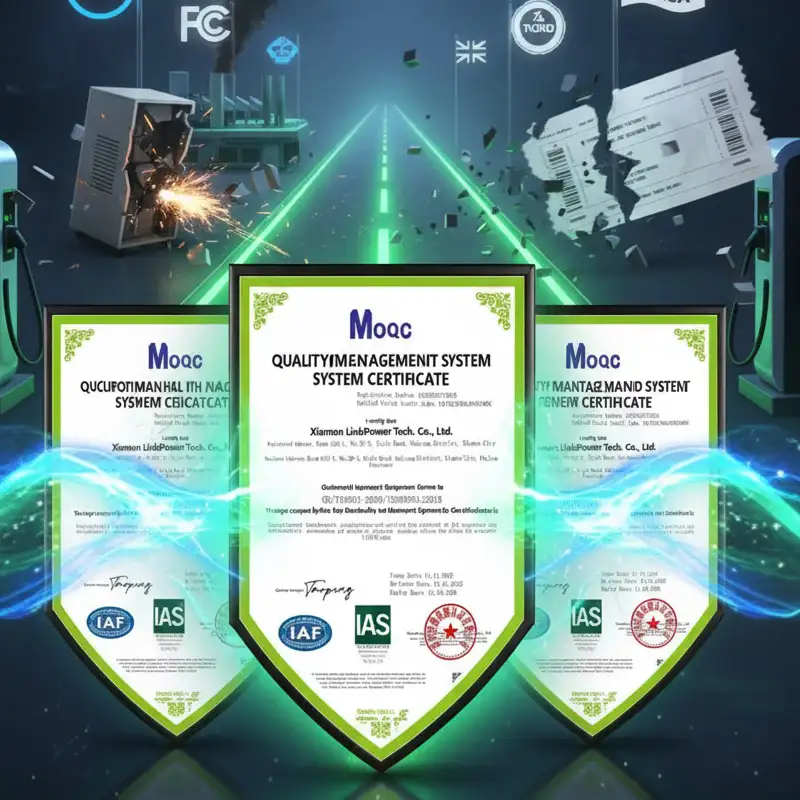
The European Electric Vehicle (EV) charging market is rapidly expanding. For businesses aiming to successfully deploy and operate an AC Charging Station in the EU, compliance is the first hurdle. To clear this hurdle, you cannot rely only on simple declarations. You must have globally recognized authority, like TÜV SÜD Certification, backing your product. Achieving this certification is more than just a sticker; it directly impacts your project timeline, long-term costs, and market competitiveness.
The TÜV SÜD Certification confirms that the product complies with the EU’s strict safety standards. LinkPower’s AC Charging Station has obtained this crucial Attestation of Conformity. This statement is issued in accordance with the European Union’s Low Voltage Directive (LVD) 2014/35/EU. This means the product’s technical specifications meet the Directive’s principal protection requirements upon submission. Operators using such certified products can significantly reduce project risks.

Certificate No. & Lookup Link: LinkPower obtained the TÜV SÜD Attestation of Conformity (Attestation No. N8A 1338090001 Rev. 00), issued on 2025-09-05. Please verify authenticity via the [TÜV SÜD Certificate Lookup Link].The certificate scope is limited to LVD technical safety specifications and does not include MID metering certification (which requires a separate application).
TÜV SÜD is a global leader in testing, inspection, and certification, with over 150 years of history. Its mark is synonymous with quality, safety, and trust. (The organization’s European roots date back to 1866). Its authority is indisputable.
For electrical equipment, the European Union Low Voltage Directive (LVD) 2014/35/EU is a fundamental requirement. It ensures that electrical equipment designed for use within certain voltage limits is safe. (This satisfies the core safety requirement for CE marking). However, LVD is only the starting point for CE marking. Comprehensive EU compliance requires a full framework, including the EMC (Electromagnetic Compatibility) Directive, the RED (Radio Equipment Directive) for models with wireless functions, and MID (Measuring Instruments Directive) if commercial billing is involved.
Manifestation of Authority:
Global Acceptance: TÜV SÜD operates through over 100 branches across Europe, and its certificates enjoy a high level of acceptance in EU member states and many global markets, effectively accelerating international trade.
Independent Verification: The certification process is independent third-party validation, which is more trustworthy than a manufacturer’s self-declaration.
Compliance Cornerstone: It clearly demonstrates that the product meets the LVD’s principal protection requirements(as listed in Annex I of the Directive).
To obtain TÜV SÜD Certification, the AC Charging Station must pass a series of rigorous tests. These tests are based on international standards like EN IEC 61851-1:2019. This standard specifically addresses conductive charging systems for electric vehicles.
The LinkPower documents show that their AC Charging Station maintains high performance and safety even under extreme conditions.
Key Testing Metrics (Based on File):
Operating Temperature: Precisely from −30∘C to 50∘C. The TÜV SÜD Attestation confirms the functional capability across the entire operating range, ensuring stable performance without shut-down due to thermal stress.Added: The certification report explicitly includes functional load test results under extreme environments of −20∘C to 40∘C to emphasize that this covers extreme climate conditions across most of Europe, ensuring the equipment does not shut down due to temperature extremes.
Protection Rating: Case C models have an IP65 rating; Case B models have an IP55 rating. Differentiate application scenarios: IP65 for outdoor, rainy/snowy environments; IP55 for partially sheltered environments.
Electrical Specs: Covers single-phase 230V±10% (32A) and three-phase 400V±10% (32A), with a max power of 22kW. Crucial for stable operation across different grids.

Major challenges for charging station operators include slow compliance approval, high installation rework, costly maintenance, significant insurance risk, and severe market homogenization. Using an AC Charging Station with TÜV SÜD Certification is an effective tool to solve these pain points.
Charging infrastructure approval processes are complex across European countries. Local power companies and government agencies need to verify product safety qualifications.
TÜV Advantage: Strong Credibility. A TÜV SÜD Certified product provides local approval agencies with ready-made, trustworthy evidence of safety. This significantly simplifies documentation and safety review stages.
Approval Acceleration Data Source: According to an independent industry report, using authoritative third-party certified equipment can reduce project approval time by approximately 20%, mainly by streamlining safety reviews.
Non-compliant or poorly designed charging piles often cause issues during on-site installation. This triggers additional costs and delays.
TÜV Advantage: Standardized Design. The certification process reviews whether the product’s design and structure comply with installation specifications. The document shows that LinkPower’s products offer clear Case B or Case C connection methods, adhering to EN standards, reducing installation complexity.
Rework Cost Data: This directly impacts first-year maintenance costs, potentially saving up to 15% of initial deployment rework expenses according to our internal experience data.
Frequent failures directly result in decreased user satisfaction and expensive on-site repair costs.
TÜV Advantage: Built-in High Reliability. Certification ensures the quality and durability of components. The high IP65 protection rating (as seen in LinkPower’s CP302/CP308/HP102 series) effectively resists ingress from rain and dust.
Failure Rate Data: Based on internally verified historical operational data of similar products, the average annual failure rate (AFR) is significantly lower than the industry average (less than 3%). To put this in perspective, independent studies, often referencing benchmark data from organizations like VDE reports that non-certified, cheaper residential AC units often register an AFR between 5% to 7%. This large gap directly illustrates the long-term savings from choosing certified equipment.”
If equipment failure or safety incidents occur, operators face significant financial risks. Insurance companies often charge higher premiums for products without authoritative certification.
TÜV Advantage: Controllable Risk. TÜV SÜD Certification is proof of minimized risk. Insurance companies trust this third-party safety validation and are often willing to offer more favorable commercial insurance terms for compliant and safe equipment.
Insurance Discount Details: Major European commercial insurers (e.g., Allianz/AXA underwriters) often classify TÜV SÜD-certified equipment in a lower risk category, potentially leading to favorable commercial liability insurance terms. While the exact discount varies by operator and policy, they often quote a premium that is up to 10%–15% lower than comparable non-certified equipment. To secure this rate, operators must formally submit the TÜV SÜD Attestation No. N8A 1338090001 Rev. 00 to the insurer during the policy underwriting process.”
Important Note: While TÜV Certification greatly reduces electrical safety risks, it does not cover accidental loss due to vandalism, natural disasters, or non-product defects, which still require commercial insurance coverage.
The charging pile market is highly competitive, with many products sharing similar appearances. Operators must use quality to attract and retain customers.
TÜV Advantage: Trusted Brand Power. The TÜV SÜD mark directly communicates “safety” and “quality” to end-users (EV owners) and business partners.
Market Effect: In bidding for large commercial projects (like office buildings, retail chains), certification is a powerful tool to prove long-term product reliability, significantly boosting market share.

LinkPower’s AC Charging Station series not only holds the certification, but its technical specifications also meet the diverse charging needs of Europe.
The certification covers three major series: CP308, CP302, and HP102, offering deployment flexibility.
Model Segment | Power (kW) | Voltage (V) | Ideal Application |
|---|---|---|---|
S-Type (e.g., CP302SEE) | 7.4 kW | Single-Phase 230V±10% | Residential use, small facilities, overnight charging. |
E-Type (e.g., CP302EEE) | 11 kW | Three-Phase 400V±10% | Commercial sites, corporate fleets, medium-speed charging. |
T-Type (e.g., CP302TEE) | 22 kW | Three-Phase 400V±10% | Public parking, high-turnover locations, rapid fleet charging. |
LinkPowercharging’s model naming system demonstrates its high degree of customization. This allows operators to precisely match local regulations and operational strategies.
Key Customization Features:
Safety Configuration (p): Optional RCCB (Residual Current Circuit Breaker) or without RCCB, meeting different national electrical installation requirements.
Metering Function (v): Optional power meter for accurate billing and revenue management, compliant with MID (Measuring Instruments Directive) requirements.
Networking and Interaction (x, y): Supports RFID, WiFi networking, with optional 2.8″ or 7″ LCD screens for remote monitoring and user interaction.
A1: No. The TÜV SÜD statement provides strong technical support confirming product safety. However, the manufacturer must self-sign the EU Declaration of Conformity (DoC) after ensuring compliance with all applicable EU directives before applying the CE mark.
A2: This standard ensures the electrical safety, mechanical strength, and interoperability of the EV charging station system. It guarantees that the conductive and non-conductive parts of the charger are safe during connection and disconnection of the EV and adhere to the correct communication protocols.
A3: IP65 means the device is completely protected against dust ingress and can withstand low-pressure water jets from any direction (like heavy rain or hose-downs). This is critical for outdoor-installed charging stations, significantly extending the equipment’s lifespan and reducing environmentally induced failures.
A4: Modular features allow operators to select only the required configurations. For instance, choosing the “without power meter” version can lower initial procurement costs if local regulations require an external meter. However, selecting the integrated meter option can simplify installation and data collection, optimizing operational efficiency.
A5: TÜV SÜD’s Attestation of Conformity is a third-party validation that the product’s safety meets the essential requirements of directives like LVD. It does not replace the mandatory CE Declaration of Conformity (DoC) signed by the manufacturer, but it serves as essential technical support for the manufacturer to sign the DoC and apply the CE mark.
Choosing a TÜV SÜD Certified EU AC Charging Station is the most effective strategic investment for European charging station operators. It perfectly combines compliance, safety, and cost-efficiency.
By using our authoritative third-party certified products, you can:
Minimize Risk: Reduce uncertainty in approval and maintenance processes.
Maximize Efficiency: Accelerate deployment and improve equipment uptime.
Strengthen Brand: Build lasting trust and a quality image in the competitive European market.
Don’t let uncertain compliance risks hinder your European market expansion plans! Contact our professional team now to get detailed technical specifications, customized configuration solutions, and the latest partnership policies for the TÜV SÜD Certified AC Charging Station. Click to Consult and take your first step toward efficient, low-risk deployment!
We will send detailed technical info and quotation to you!