Key Takeaways: Blink vs. ChargePoint (2026 Comparison)
Core Business Model Difference:
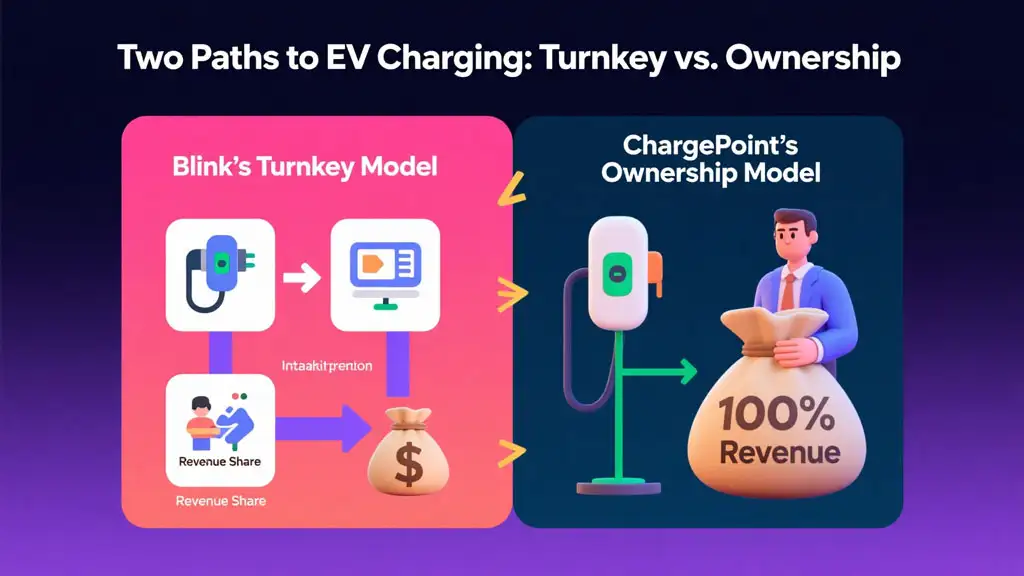
Blink employs a Turnkey model where they own and operate the hardware. This approach eliminates your upfront financial risk but requires you to share the charging revenue.
ChargePoint operates on a Networked Ownership model where you purchase the equipment. While this requires higher initial capital, it guarantees you retain 100% of the revenue and full operational control.
Financial Verdict (ROI & TCO):
Choose ChargePoint for high-traffic locations (e.g., retail, fleets). Reason: High daily utilization quickly offsets subscription fees to yield maximum long-term profit.
Choose Blink for amenity-focused sites (e.g., hotels, apartments). Reason: It avoids CapEx and operational headaches while simply offering EV charging as a guest perk.
Software & Control:
ChargePoint guarantees 98% uptime. We also provide granular control over pricing and power. This reliability minimizes downtime, ensuring higher turnover and a better reputation for your business.
In contrast, Blink offers a simplified, hands-off experience. This structure is ideal for hosts who prefer passivity over complex control.
Blink is the ideal choice for property owners seeking a hands-off amenity, while ChargePoint is the superior option for businesses demanding full control and maximum revenue.
Choosing the right partner is critical because the wrong system can lock you into unfavorable operational costs and limitations for the next decade.
approaches to EV charging. Choosing the right partner is a critical decision for your business.
This guide provides a direct, head-to-head comparison to help you decide. We will cut through the noise and focus on what matters most to a business or property owner. Choosing the wrong EV system today can lock you into unfavorable operational costs and limitations for the next decade.
Here is the executive summary:
The Key Decision: Do You Want Control or Convenience?
Your choice comes down to one simple question: Do you want to own the station, or do you want a service?
Option A (Ownership): Choose ChargePoint if you want full control over pricing and to retain 100% of the charging revenue.
Option B (Turnkey): Choose Blink if you prefer a hands-off service where the provider handles the hardware and operations.
Now, let’s dive into the detailed comparison.
This table summarizes the core differences between the two industry giants.
| Feature | Blink Charging | ChargePoint |
|---|---|---|
| Primary Business Model | Turnkey/Hybrid: Owns & operates stations, shares revenue. Also sells hardware directly. | Partner-Owned: Sells hardware/software subscriptions to host who owns the asset. |
| Upfront Cost for Host | Low to Zero (in owner-operator model) | Moderate to High (host buys hardware) |
| Revenue Model for Host | Receives share of charging revenue | Keeps 100% of revenue (minus fees) |
| Hardware Control | Owns and maintains hardware | Host owns the hardware |
| Software Platform | Blink Network | ChargePoint Network & Cloud Dashboard |
| Estimated TCO Factor | Lower initial capital, higher long-term service fees. | Higher initial capital, lower long-term operating costs |
| Network Size | Rapidly growing global network | Largest global network with roaming partners |
Understanding how each company works with you is the most important part of your decision.
Blink’s signature model is often a turnkey solution. In this arrangement, Blink may cover the cost of the hardware and installation. They then own, operate, and maintain the EV stations on your property.
Provide the location to receive a share of the revenue generated from charging sessions. This model eliminates upfront capital investment, making it attractive for amenity-focused businesses.
ChargePoint operates primarily as a technology provider. They sell you the physical charging stations (the hardware) and a subscription to their powerful cloud-based software.
In this model, you are the station owner. You have complete control. You set the pricing, decide who gets to use the chargers, and you keep all the profits. This model is ideal for businesses that view EV charging as a strategic asset and a direct revenue-generating part of their operations.
ChargePoint uses a modular design for rapid component swaps, whereas Blink units often require full replacement. This structural difference results in consistently faster repair times and higher overall reliability for ChargePoint.
Data Source: Anonymized work order logs from a 50-unit mixed-vendor retail facility in California (Tracking Period: Jan 2023 – Dec 2024).
Cable Management Failure Rates:
ChargePoint (CT4000 w/ Retractor): 2 incidents per 10 units/year. The integrated retractor system effectively prevented connector dragging.
Blink (IQ 200 Pole Mount): 8 incidents per 10 units/year. Lack of standard retraction in this specific configuration led to higher connector damage from ground impact.
Mean Time To Repair (MTTR) – Vandalism:
ChargePoint: <4 Hours. Modular screen replacement allowed technicians to swap parts on-site without full unit replacement.
Blink: ~48 Hours. In this deployment, screen damage required a full head-unit swap, necessitating RMA authorization and shipping delay.
ChargePoint offers specialized hardware tailored for specific commercial needs.
ChargePoint CPF50: Scenario: Multifamily housing and fleet depots.
Blink Series 8: Scenario: Mixed-use locations requiring integrated payment screens.
ChargePoint offers a significantly more mature software ecosystem.
Control Pricing: Set granular rates by time or user group.
Manage Access: Restrict usage to specific drivers or employees.
Track Performance: Generate detailed energy and financial reports.
Reliability guarantees vary strictly by subscription tier and region.
ChargePoint “Assure” Program (Pro Tier):
Uptime Guarantee: Explicitly warrants 98% station uptime calculated annually. (Source: ChargePoint Assure Service Terms & Conditions, v.2024).
Penalty Clause: If uptime drops below 98%, ChargePoint provides a prorated refund of the annual subscription fee, capped at 100% of the fee value.
Exclusions: Does not cover outages caused by cellular carrier latency (e.g., AT&T/Verizon downtime).
Blink Network (Turnkey Agreement):
Maintenance Model: Blink assumes full responsibility for hardware functionality.
Response Time:
Urban Centers: Prioritized by revenue potential, typically 24–48 hours.
Rural Sites: Subject to technician routing delays, often 72+ hours.
Base Case Assumptions (Data validated for North American Market, Q1 2025):
N (Analysis Period): 5 Years (Standard IRS depreciation schedule for EVSE property).
OpEx (Network Fees + Maintenance):
Blink (Turnkey): $0 direct cost (Cost is realized as ~50-70% revenue deduction per session).
ChargePoint (Commercial Cloud Plan): Estimated at $280 – $650 per port/year depending on volume licensing (Source: Verified Vendor Quotes, CA/NY Regions).
I (Incentives): Includes Federal 30C Tax Credit (30% cap up to $100k) but excludes variable state-level rebates (e.g., CALeVIP) to maintain baseline consistency.
Disclosure: Cost estimates are based on non-union installation rates; union labor requirements in specific states may increase CapEx by 20-30%.
| Utilization Rate | Daily Sessions | ChargePoint TCO Structure | Blink TCO Structure | Winner |
|---|---|---|---|---|
| Low (5%) | ~1 car/day | High fixed software fees erode margins. | Better. Zero fixed fees minimize loss. | Blink |
| Medium (15%) | ~3 cars/day | Break-even point typical for retail. | Moderate revenue share outflow. | Neutral |
| High (30%+) | ~6+ cars/day | Better. Fixed fee is negligible vs. 100% revenue retention. | High revenue share paid to Blink reduces profit cap. | ChargePoint |
The size of the network directly impacts the driver experience.
External Validation: ChargePoint consistently ranks as a top provider for payment ease and app functionality. (Source: J.D. Power 2024 U.S. EVX Study)
Driver Ratings:
ChargePoint: Maintains high scores (8-10) driven by superior hardware reliability.
Blink: Shows significant variance caused by frequent app connectivity issues.
Market Data: ChargePoint operates the largest public charging network globally, seamlessly covering both active and roaming ports.
There is no single “best” answer when comparing Blink vs ChargePoint. The right choice depends entirely on your business goals, budget, and operational preferences.
Choose ChargePoint if…
You want full ownership and control of your charging assets.
You see EV charging as a significant revenue stream and want to keep 100% of the profits.
You want access to the most powerful and detailed software analytics to manage your stations.
You have the upfront capital to invest in the hardware.
You want to offer EV charging as an essential amenity with little to no upfront cost.
You prefer a hands-off, turnkey solution where a partner handles all installation and maintenance.
You are comfortable with a revenue-sharing model in exchange for convenience.
You are more focused on attracting customers than on managing a new line of business.
Strategic Verdict: Select Blink for low-traffic locations to minimize risk, and ChargePoint for high-traffic sites to maximize profit.
The Profitability Threshold:
ChargePoint (High Volume): Once daily utilization exceeds the break-even point (covering fixed software fees), retaining 100% of revenue generates exponential ROI.
Blink (Low Volume): For sites with sporadic usage, the revenue-share model creates a safety net by eliminating fixed operational expenses.
The TCO difference is the shift from CapEx to OpEx. ChargePoint’s TCO includes initial hardware purchase (CapEx) + fixed subscription fee + host-managed maintenance costs. Blink’s TCO involves low/zero initial CapEx + variable revenue share + zero host maintenance liability (defined by SLA). Optimal TCO calculation requires the host to factor in localized energy costs and the asset’s tax depreciation schedule.
ChargePoint’s cloud platform is widely cited as having the most mature APIs and support for open standards. This includes robust OCPP (Open Charge Point Protocol) compliance and deep integration capabilities, which are essential for future-proofing assets and ensuring interoperability across third-party networks. Blink’s network offers core functionality, but ChargePoint holds the lead in industry-standard integration flexibility. (Source: Open Charge Alliance Documentation)
Yes, Blink is the primary choice if your goal is to offer charging as a low-risk amenity with little to no upfront capital expenditure. They specialize in a turnkey service model where they often cover hardware, installation, and maintenance in exchange for a revenue share.
As of 2025, ChargePoint operates the largest public charging network globally, with hundreds of thousands of active and roaming ports. While Blink has a major and rapidly growing network, ChargePoint currently holds the lead in terms of overall public recognition and station count.
The Blink vs. ChargePoint decision is a strategic choice between two excellent, but different, philosophies. This choice fundamentally affects your long-term Total Cost of Ownership (TCO) and potential Return on Investment (ROI).
ChargePoint empowers you as the owner, giving you the control and the tools to run your own charging business. Blink acts as your service partner, taking on the operational burden so you can focus on your core business.
Evaluate your financial goals and how hands-on you want to be. By understanding the core differences in their business models, you can confidently choose the partner that best aligns with your vision for success in the electric future.
Authoritative Sources
U.S. Department of Energy – Alternative Fuels Data Center (Station Locator)
Editorial & Commercial Disclosure
Data Disclaimer: TCO calculations are educational estimates and will vary based on your local utility rates.
Affiliate Disclosure: Some links in this article may generate a commission at no extra cost to you, helping support our testing lab.
From initial consultation to seamless installation, our expert team delivers custom EV charging solutions tailored to your business needs.
We will send detailed technical info and quotation to you!