The adoption rate of electric vehicles (EVs) is accelerating. One primary reason consumers choose EVs is the continuous progress in battery technology, which significantly enhances vehicle range and performance. However, what truly transforms the EV driving experience is the improvement of the charging infrastructure and the various types of EV chargers available.
Within this charging system, the Level 3 Charging Station is a genuine game-changer.
The Level 3 Charging Station, technically referred to as an Off-Board Charger under standards like SAE J1772 (North America) and IEC 61851 (Global), is designed to bypass the limitations of a vehicle’s onboard hardware. Unlike Level 1 or 2 AC chargers that rely on the car’s internal converter, Level 3 stations rectify AC power from the grid into high-voltage DC (Direct Current) explicitly for rapid energy replenishment.
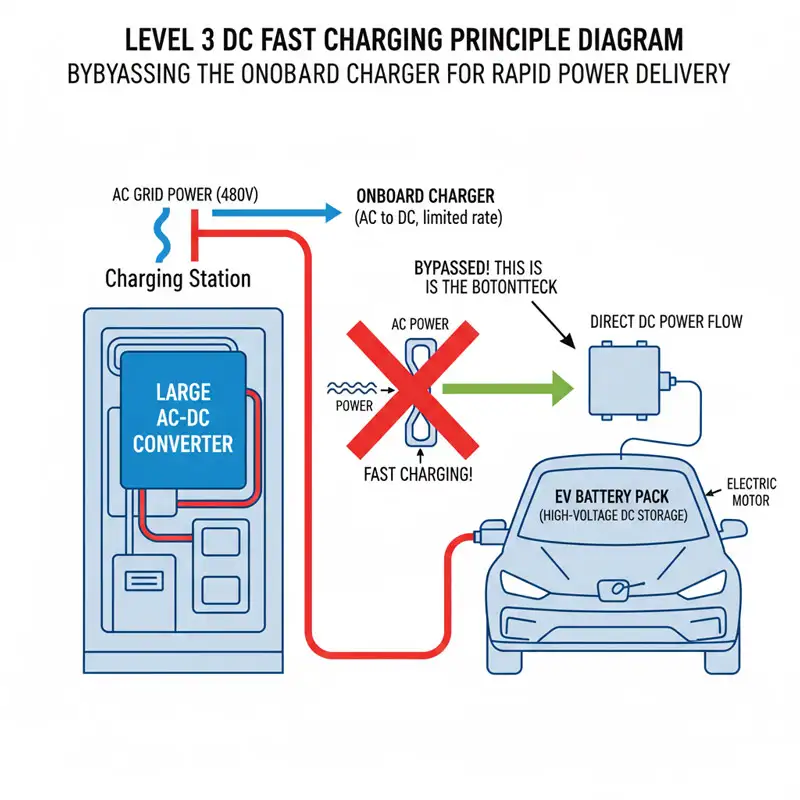
The Level 3 Charging Station fundamentally differs from the common home chargers we see. This distinction lies in the type of current and power output.
The Level 3 Charging Station is a type of advanced charging equipment. It is specifically designed for electric vehicles (EVs) to provide extremely high charging power. Its goal is to enable EVs to regain the majority of their charge in the shortest possible time.
The “DC” in DC Fast Charge stands for Direct Current. Home power and Level 1/Level 2 chargers use Alternating Current (AC).
All electric vehicles’ batteries store energy in the form of Direct Current (DC).
When you use Level 1 or Level 2 Alternating Current (AC) charging, the electric energy first enters your vehicle.
Inside the car, there is an onboard charger. It is responsible for converting the AC power into DC power so it can be fed into the battery.
This onboard charger is small and limited in power, which results in slower charging speeds. It acts like a narrow pipe.
The core of a Level 3 station lies in its power modules. For example, in our own Linkpower 540KW modular stacking systems, multiple 20kW-40kW power modules work in parallel to rectify grid AC power into DC. This power allows for amperage throughputs often exceeding 500A. Crucially, this current bypasses the vehicle’s On-Board Charger (OBC)—which is typically the bottleneck limited to 7kW or 11kW—and connects directly to the Battery Management System (BMS). This “direct injection” method is why efficiency jumps significantly, reducing energy conversion loss compared to AC charging.
This is like using a fire hose for irrigation rather than a garden hose. It significantly reduces energy loss and boosts the charging speed by more than 10 times.

| Charging Level | Alias/Power Type | Typical Voltage | Typical Power (kW) | Range Added per Hour (Approx.) | Applicable Scenario |
|---|---|---|---|---|---|
| Level 1 | AC Slow Charging | 120V (NA) / 230V |
1.8 – 2.4 kW | 5 – 10 km | Home overnight charging, emergency use |
| Level 2 | AC Medium Speed Charging | 240V / 230 – 400V |
3.6 – 22 kW | 40 – 120 km | Home daily charging, workplace, commercial centers |
| Level 3 | DC Fast Charging | 400V – 900V+ |
25 – 350 kW | 200+ km (30-60 minutes) |
Highway service areas, urban rapid replenishment |
| Feature | Standard 3-Phase Installation | Linkpower 28kW (Single-Phase) |
|---|---|---|
| Input Voltage | 480V AC (Requires Transformer) | 208V – 240V AC (Standard) |
| Grid Upgrade Cost | Avg. $45,000+ | $0 – $2,000 |
| Permitting Time | 3 – 6 Months | < 2 Weeks |
| Deployment Method | Trenching & New Service Drop | Plug-and-Play into NEMA 14-50 |
| Connector Name | Full Name/Features | Main Regions and Vehicle Models Used | Compatibility Status |
|---|---|---|---|
| CCS (Combined Charging System) | Combined Charging System, combines AC and DC ports | Europe, North America. Most non-Tesla models like Ford, GM, VW, Hyundai. | The most widely adopted open standard globally. |
| NACS (North American Charging Standard) | North American Charging Standard, proprietary to Tesla | North America. Currently used exclusively by Tesla, but announced to open to all automakers. | Tesla-led trend toward unification; many major automakers will adopt starting in 2025. |
| CHAdeMO | Originating in Japan, separate from AC port | Asia. Used by some older models like Nissan Leaf and Mitsubishi. | Market share is gradually declining, but still used by some older vehicles. |

Users often ask: Is Level 3, being so fast, also particularly expensive? The answer is yes, but we need to understand the reasons behind it.
The cost of Level 3 charging stations is typically higher than Level 1 or Level 2 charging.
Why are public fast-charging prices higher?
Deep Dive: The “Demand Charge” Challenge The primary driver of Level 3 cost isn’t just the electricity consumed (kWh), but the Demand Charge. Utility providers monitor usage in 15-minute intervals. If a 350kW charger runs at full power for just one interval in a month, the utility sets the rate for that entire month based on that single peak spike.
Expert Insight: This is why commercial operators often install Battery Energy Storage Systems (BESS) or use Dynamic Load Balancing. By shaving these peaks (Peak Shaving), operators can significantly lower operational costs—a strategy we implement in our megawatt-level scalable solutions.
Infrastructure and Maintenance Costs: The purchase and installation costs for Level 3 equipment are high, and maintenance is complex. Operators need to recover this investment through higher rates.
Difference in Billing Models:
Billing by kWh: Charges are based on the actual electricity consumed, for example, $0.40 – $0.60 per kWh. This is the fairest model.
Billing by Time (minutes): Charges are based on the duration the charging station is occupied. If your vehicle’s charging speed slows down due to battery protection, this model is disadvantageous to you.
Efficient use of Level 3 charging stations is key to eliminating range anxiety.
Use Dedicated Apps: Applications like PlugShare, ChargePoint, and Electrify America provide real-time maps, connector types, availability, and user reviews.
Utilize In-Vehicle Navigation: Most modern EVs have built-in charging planning features in their navigation systems, which automatically recommend charging stations based on range and route.
Charging Etiquette: Charging speed drastically slows down for most EVs after the state of charge exceeds 80%. To maintain efficiency and avoid unnecessary fees, please unplug your vehicle promptly upon reaching 80% to leave the station free for the next user who needs fast charging.
The dream of having a Level 3 charging station in your home garage is impractical.
Electrical Infrastructure Limitations:
Standard residences typically only have 120V or 240V single-phase electricity.
Level 3 charging stations require 480V or even higher voltage three-phase industrial power.
Cost and Complexity:
The equipment itself costs tens of thousands of dollars.
Installation requires rewiring, adding transformers, and professional electrical upgrades, with total costs potentially exceeding $50,000 to $100,000.
Safety requirements and maintenance difficulty far exceed those of a home Level 2 charger.

While Level 3 charging stations are convenient, they also present technical and environmental challenges that must be addressed.
User anxiety about fast charging damaging batteries is widespread.
The Science of Degradation: Lithium Plating and SEI While heat is a factor, the technical risk during high-amperage charging is Lithium Plating. If ions move faster than the anode can absorb them (common in cold temperatures or extreme fast charging), metallic lithium forms on the anode surface, permanently degrading capacity. However, modern Battery Management Systems (BMS) effectively mitigate this by strictly controlling the “Charging Curve.” The BMS will throttle speed significantly once the battery reaches ~80% SoC or if internal cell temperatures exceed safe thresholds (typically 45°C), protecting the Solid Electrolyte Interphase (SEI) layer from breakdown.
Modern Solutions:
BMS Protection: Modern EVs have advanced Battery Management Systems (BMS). The BMS monitors temperature in real-time and automatically limits charging speed when necessary to ensure the battery operates within a safe range.
Liquid Cooling Technology: Most Level 3-capable EVs are equipped with sophisticated liquid cooling systems to actively manage heat.
Usage Recommendation: Reserve DC Fast Charging for long-distance travel and emergencies. Daily commuting and home charging should primarily use Level 2 slow charging to maximize battery longevity.
Level 3 charging stations pose a significant challenge to the power grid.
High Power Impact: The power demand of a single 350kW charging pile can equal the total consumption of hundreds of average households. Large-scale deployment may lead to local grid voltage fluctuations or even overload.
Necessity of Grid Upgrades and Energy Storage: Solutions to alleviate grid pressure include:
Upgrading local substations and transmission lines.
Deploying Energy Storage Systems on-site at charging stations to store electricity during off-peak hours and release it during peak charging times, thus easing the grid’s load.
For commercial investors, Level 3 charging stations represent high risk and high reward.
High Investment Threshold: The unit cost for a commercial Level 3 charging pile typically ranges from $40,000 to $175,000.
Complex Compliance: Installation must comply with strict electrical regulations, fire safety standards, and accessibility requirements, resulting in lengthy and complex installation and permitting processes.
Challenges and Returns: Successful operation requires high vehicle traffic and a reasonable electricity pricing structure; otherwise, operational costs (especially demand charges) may be difficult to cover.
Manufacturing and Installation Impact: The production and installation of these complex Level 3 EV Chargers require significant energy and raw materials, resulting in carbon emissions.
Dependence on Electricity Source: Although the electric vehicle itself is zero-emission, the overall sustainability is compromised if the electricity used by the charging station comes from fossil fuels like coal power generation.
The Level 3 charging network is rapidly expanding, primarily dominated by a few major players.
| Operator | Core Advantage and Features | Connector Standard |
| Tesla Supercharger Network | (Tesla Supercharger Network) Extremely high reliability, excellent user experience, currently opening up globally to CCS. | NACS (Open or in the process of opening) |
| Electrify America | (EA) Backed by the Volkswagen Group, a leading open charging network in the U.S., focusing on sustainability and energy storage. | CCS, CHAdeMO |
| IONITY | Joint venture of major automakers like BMW, VW, and Ford, focusing on ultra-high-speed charging along major European highways. | CCS |
| EVgo and ChargePoint | Leading charging solution providers, mainly deployed in urban centers, commercial areas, and public spaces. | CCS, CHAdeMO |
Level 3 charging technology is set to undergo two major revolutionary breakthroughs in the coming years.
Level 3 charging stations are primarily suitable for Battery Electric Vehicles (BEVs). Almost all modern BEVs support Level 3 DC fast charging. Plug-in Hybrid Electric Vehicles (PHEVs) generally do not support it because their battery packs are smaller and cannot withstand the high current and heat associated with fast charging.
You need to consult your vehicle’s owner’s manual or check the maximum charging power limit displayed on your car’s dashboard. Even if the charging pile shows 350kW, your vehicle will automatically negotiate a safe maximum charging power based on its own BMS limits and battery temperature.
Due to their high power and infrastructure requirements, Level 3 charging stations are mainly deployed in commercial areas that require quick turnover. Common locations include highway service areas, long-distance rest stops, large shopping centers, near gas stations, and dedicated charging hubs.
Modern research indicates that for EVs equipped with advanced BMS and liquid cooling systems, the additional degradation caused by occasional use of Level 3 fast charging is negligible. Unless more than 80% of your charging relies on fast charging, you generally do not need to worry excessively. Daily L2 charging and avoiding keeping the battery at 100% or near 0% for long periods are more important battery maintenance habits.
The profit model for Level 3 charging stations primarily includes: 1) charging users high fees based on energy consumed (kWh) or time; 2) attracting high-value EV users to commercial premises, increasing retail or service revenue; 3) potential government tax credits and subsidies. The biggest operational challenge is the high cost of “demand charges.”
We will send detailed technical info and quotation to you!