Are EV Charging Stations Profitable? Yes—if you control four variables: local energy tariffs (incl. demand charges), utilization, installation scope, and incentives. This guide shows L2 vs DCFC ROI with a calculator, a site-selection framework (P.L.A.C.E.), and geo-specific checks so you can forecast payback before you invest. This guide moves beyond the simple question of whether EV charging stations are profitable and instead provides a real-world financial framework, actionable strategies, and a data-driven business case for your EV charging business, highlighting the numerous benefits of EV charging stations.
The first step is to stop viewing profitability as a single, static number. It’s a dynamic equation. While the basic formula is simple—Profit = Total Revenue – Total Costs—true potential lies in the Three-Tier Revenue Model, which accounts for every way a charging station adds value. The Three-Tier Revenue Model:
Tier 1: Direct Revenue: The most obvious income stream, generated by selling electricity to drivers.
Tier 2: Indirect Revenue: The often-underrated value the station brings to your primary business. This tier is frequently the most profitable aspect for retailers and hospitality businesses.
Tier 3: Future Revenue: Potential income from emerging technologies, such as selling power back to the grid (V2G) or earning carbon credits. Most analyses only consider Tier 1. This guide will show you how to leverage all three.
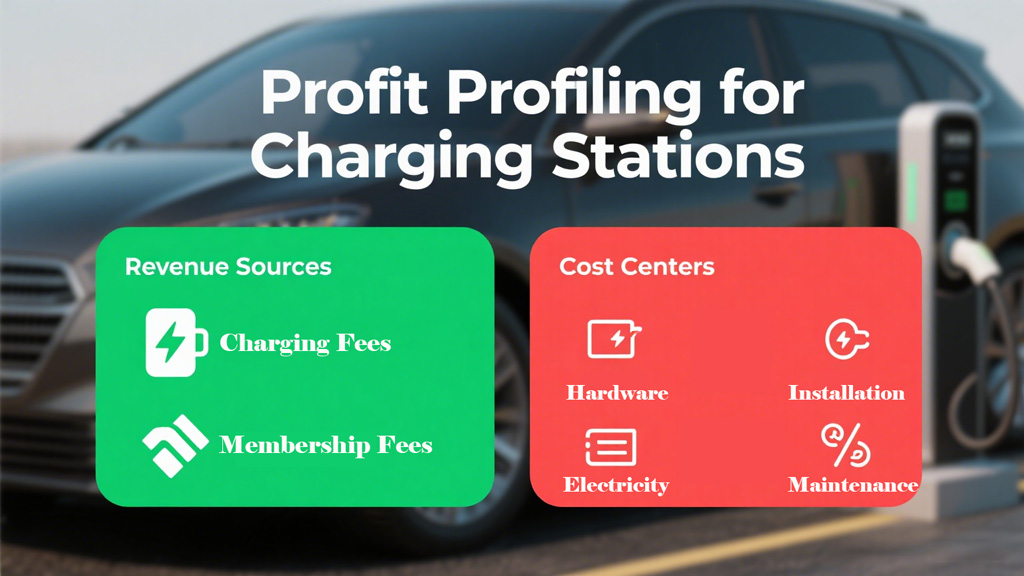
Before you invest a single dollar, you need to map out your potential income and expenses. This is how you determine your potential EV charging station profit margin.
How do EV charging stations make money? You have several options for pricing, each with its pros and cons.
Per-kWh (Kilowatt-hour) Fees: The most common and fair method. Drivers pay for the exact amount of energy they consume.
Per-Hour or Per-Minute Fees: Simple to implement. This is common for Level 2 charging where people park for longer periods.
Flat Session Fees: A single price per charging session. Predictable for drivers but can be unfair for those who only need a small top-up.
Subscription/Membership Fees: Offer lower rates to loyal, repeat customers who pay a monthly or annual fee. This creates a stable, recurring revenue stream.
Idle Fees: A crucial tool. These are per-minute fees that kick in after a vehicle is fully charged but remains plugged in, encouraging drivers to move and freeing up the spot for the next customer.
Advertising & Partnerships: Sell ad space on the charger’s screen or partner with a nearby coffee shop to offer a discount to charging customers.
Costs can be broken down into two categories: one-time capital expenses and recurring operational expenses.
Hardware Costs: The price of the physical electric vehicle equipment. According to the U.S. Department of Energy, Typical installed ranges (hardware+installation): L2 $6k–$20k per port; DCFC $50k–$150k+ per dispenser depending on power and make-ready scope. Provide a cost breakdown table (equipment, make-ready, networking, commissioning).
| Charger Type | Installed Cost (per port/dispenser) | Equipment | Electrical Make-Ready | Networking (Year 1) | Commissioning |
|---|---|---|---|---|---|
| Level 2 (AC) | $6k – $20k per port | Typical $2k – $6k | Typical $3k – $12k (trenching, panel work, permits) | $200 – $500 / port (not included in installed total) | $500 – $1.5k per site |
| DC Fast (DCFC) | $50k – $150k+ per dispenser | Typical $30k – $80k (power-dependent) | $15k – $70k+ (transformer/service upgrades possible) | $500 – $1.5k / dispenser (not included in installed total) | $1k – $5k per site |
Notes: Ranges vary by power rating, site conditions, utility requirements, labor, and permitting.
Installation Costs: This is a major variable. It includes labor, trenching, permits, and potentially costly electrical upgrades to your site. Make-ready can match hardware cost.
Software Setup Fees: The initial cost to get your station connected to a management network.
Enter your estimates to project financial returns.
Network, maintenance, etc.

You can have the best equipment in the world, but if it’s in the wrong spot, it won’t make money. Use our P.L.A.C.E. framework to evaluate potential sites like a pro.
P – Population & EV Penetration: Is the site in an area with a high concentration of EV owners? Check local vehicle registration data. A wealthy, tech-savvy demographic is a strong indicator.
L – Loitering Time (Dwell Time): How long do people naturally stay at this location?
High Dwell Time (Ideal for Level 2): Workplaces, apartment buildings, hotels, movie theaters, sit-down restaurants.
Low Dwell Time (Ideal for DC Fast Chargers): Convenience stores, fast-food restaurants, major highway corridors.
A – Accessibility & Visibility: Can drivers see the station from the road? Is it easy to get in and out? A poorly designed site with difficult access will deter users. This is a critical element of EV charging station design.
C – Competition: What other public chargers are nearby? Use an app like PlugShare to scout the competition. If a nearby site is always full, that’s a great sign of unmet demand.
E – Electrical Capacity: Does the site have sufficient electrical infrastructure? Contact the local utility company early. A site that requires a new transformer could add $50,000+ to your installation cost, killing your profitability before you even start.
All ROI outputs depend on local tariffs, demand charges, construction scope, and incentives. Always validate with your utility and AHJ before purchase.
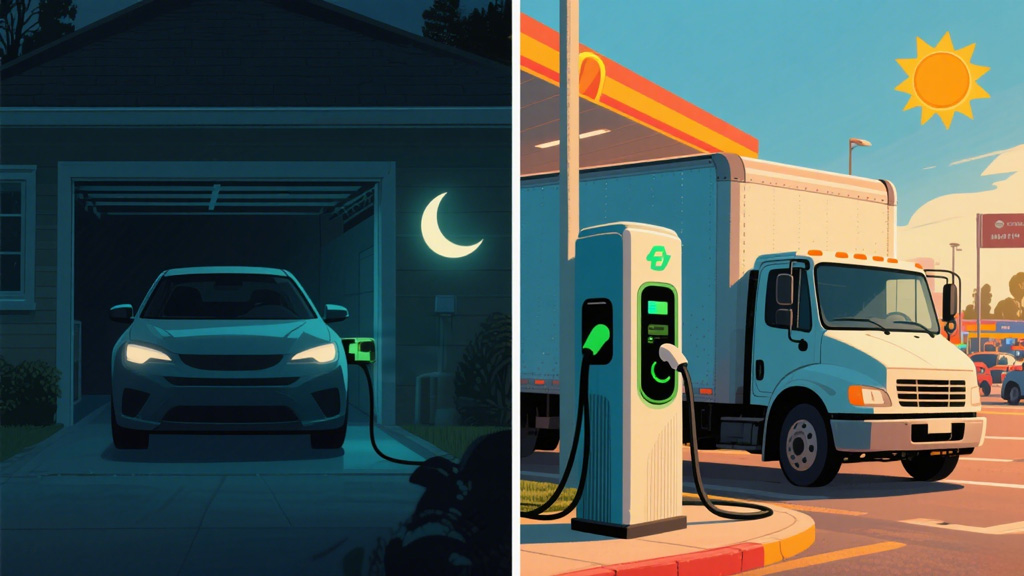
| Feature | Level 2 AC Charger | DC Fast Charger (DCFC) |
|---|---|---|
| Ideal Location | Workplace, Residential, Hotel | Highway, Retail, Fleet Depot |
| Target Dwell Time | 2 – 8 hours | 15 – 45 minutes |
| Upfront Cost | Low ($6k – $20k installed) | Very High ($50k – $150k+ installed) |
| Electricity Costs | Low (minimal demand charges) | Very High (significant demand charges) |
| Revenue Per Session | Lower ($5 – $15) | Higher ($15 – $30+) |
| Customer Turnover | Low | High |
| Primary Profit Model | Indirect Revenue (Attracting tenants/shoppers) | Direct Revenue (Selling energy as a primary business) |
| Payback Period | Longer (but lower risk) | Potentially shorter (but much higher risk) |
For DC fast charging, demand charges often dominate OpEx. If the utility uses a monthly demand ratchet, estimate peak kW as:
Peak kW ≈ (Number of dispensers × Rated kW × Concurrency %) ÷ Power-sharing factor
Monthly demand-charge cost = Peak kW × $/kW (demand tariff).
Example: Two 150-kW dispensers, 60% concurrency, no power-sharing, $18/kW demand charge → Peak ≈ 180 kW; demand charge ≈ 180 × $18 = $3,240/mo.
Break-even utilization (DCFC) ≈ (CapEx amort./mo + OpEx/mo) ÷ (Gross margin/kWh × kWh per full-power hour).
At workplaces/hotels, many L2 sites plan for 8–15% utilization to break even when energy margin is $0.20–$0.35/kWh and OpEx is $200–$500/port/month.
For many businesses, especially retailers and hospitality, the real money isn’t in the charging fees. It’s in the customers the chargers attract. These are some of the most overlooked benefits of eV charging stations.
Increased Foot Traffic: EV drivers plan their trips around charging. A 2022 study found that 65% of EV drivers are more likely to shop at a store that offers charging.
Longer Dwell Time = Higher Spend: While their car charges for 30-60 minutes, drivers will shop, eat, or use your services. If a non-EV driver spends $20 in 15 minutes, an EV driver who stays for 45 minutes might spend $50.
Enhanced Customer Loyalty: Offering charging is a powerful amenity that builds loyalty and leads to repeat visits.
Competitive Differentiation: In a crowded market, being the only business on the block with a charger makes you the default choice for a growing, affluent customer base.
Never leave free money on the table. Federal, state, and local utility incentives can drastically reduce your upfront costs and shorten your payback period.
Federal tax credit (Section 30C): up to 30% of eligible installation costs, capped at $100,000 per project.Requirements vary by census tract and prevailing-wage rules.For current qualification details, see the official guidance on the IRS Alternative Fuel Vehicle Refueling Property Credit page and the U.S. Department of Energy AFDC Section 30C summary.(Accessed November 2025)
How to Find Incentives:
Start with the AFDC: The U.S. Department of Energy’s Alternative Fuels Data Center has a comprehensive, searchable database of all state and federal laws and incentives.
Check with Your Local Utility: Many utility companies offer their own rebates for installing smart chargers that help them manage the grid.
Consult a Professional: A reputable charging station installer will be an expert on the incentives available in your specific area.
These incentives are a core part of the many business opportunities in eV and can fundamentally change your financial projections for the better.
Q1: Are EV Charging Stations Profitable with low utilization?
A1: Profitability is possible if tariffs are stable, demand charges are managed, and incentives reduce CapEx. Many L2 sites target 8–15% utilization to break even.
Q2: L2 vs DCFC—Which is more profitable for small businesses?
A2: L2 has lower CapEx and demand-charge risk, often winning on indirect revenue; DCFC can earn higher direct revenue but needs higher utilization and grid capacity.
Q3: How do incentives affect “Are EV Charging Stations Profitable” models?
A3: Incentives can cut CapEx by up to 30%+ and shift payback by 6–18 months; always verify eligibility by tract and labor rules.
So, are EV charging stations profitable?
The answer is an emphatic yes—if you do your homework.
Profitability is not a passive outcome. It is the result of a deliberate strategy that involves:
Choosing the right location using a data-driven framework like P.L.A.C.E.
Selecting the right type of charger for that location’s needs.
Structuring your pricing intelligently to maximize revenue and turnover.
Aggressively pursuing every available government incentive.
And most importantly, understanding and quantifying both the direct and indirect value your station provides.
Stop guessing. Download the profitability calculator, start scouting locations with the P.L.A.C.E. framework, and build a business case rooted in data, not hope. The electric future is here, and it’s full of opportunity for those smart enough to seize it.
Authoritative Sources
From initial consultation to seamless installation, our expert team delivers custom EV charging solutions tailored to your business needs.
We will send detailed technical info and quotation to you!